
Product Overview
Philips 82C250 high-speed CAN bus transceiver for ISO 11898 networks, 8-lead SO package
Condition
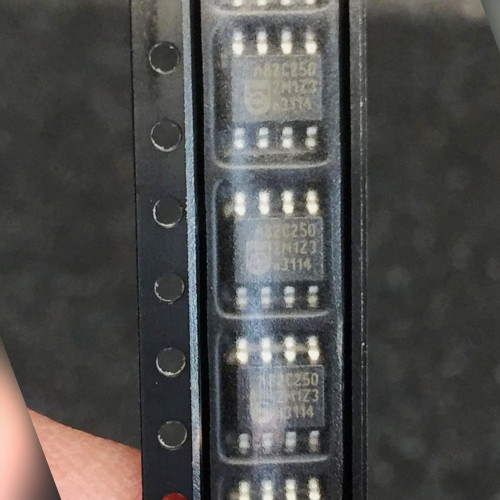
Condition: unused, new old stock (NOS). Legible marking on the photographed pieces: 82C250 on the device line. Sold each.
Same or next business day shipping from our Idaho warehouse. Reliable parts since 1999. Honest pricing, no nonsense.
Here for our customers, with a satisfaction guarantee that means what it says.
Product Overview
Philips PCA82C250T: the interface between a CAN protocol controller and the physical bus, giving differential transmit capability to the bus and differential receive capability to the controller. Philips Semiconductors became NXP Semiconductors in 2006.
Key Features
- Fully compatible with the ISO 11898 standard
- High speed, up to 1 MBd
- At least 110 nodes can be connected
- Thermally protected; short-circuit proof to battery and ground
- Differential receiver with wide common-mode range for EMI immunity
- Supply voltage: 4.5 V to 5.5 V; ambient temperature -40 C to +125 C
- SO8 plastic small outline, 8 leads, 3.9 mm body width (SOT96-1)
- Pinout: 1 TXD, 2 GND, 3 VCC, 4 RXD, 5 Vref, 6 CANL, 7 CANH, 8 Rs
Frequently Asked Questions
Is this a CAN controller?
No. It has no protocol engine. It sits between a CAN controller and the bus wires and handles the electrical side, which is why Philips called it a CAN controller interface and distributors list it as a CAN transceiver.
What does pin 8 do?
Rs is the mode-select and slope-control pin.
Is this the through-hole DIP version?
No. The T in PCA82C250T marks the SO8 surface-mount version; the DIP8 is the PCA82C250 without the T.
A CAN controller knows the protocol but cannot drive a wire; the 82C250 is the part that puts its messages onto the two bus lines and hears the replies. Give each node one and let them talk.