
Product Overview
Temperature-Compensated 50 kPa Dual-Port Millivolt-Output Sensor, Four-Lead Unibody SIP
Condition
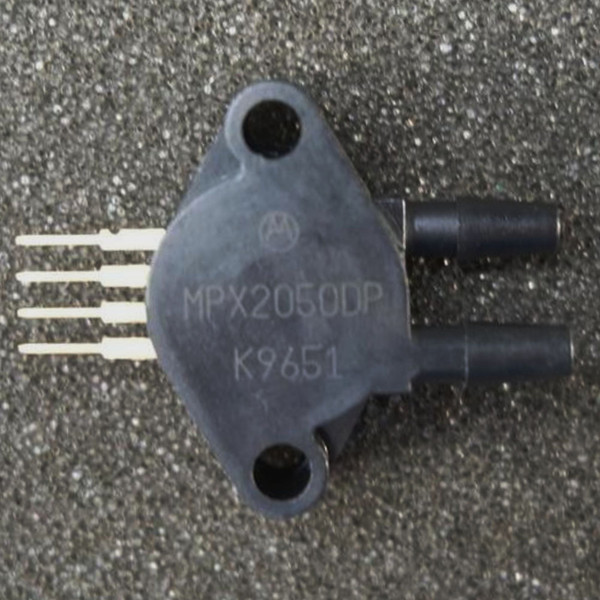
Unused new old stock (NOS). Markings legible: Motorola logo, MPX2050DP. Sold each.
Ships same or next business day from our Idaho warehouse. Honest pricing, no nonsense.
Online since 1999. Satisfaction guaranteed, every time.
Product Overview
Motorola MPX2050DP differential pressure sensor: a temperature-compensated sensor that turns the pressure difference between its two ports into a millivolt output ratiometric to the supply. It covers 0 to 50 kPa (7.25 psi) and comes in the Unibody case 344C, with both barbed ports on the same side of the body and four leads in a single row.
Key Features
- Pressure range: 0 to 50 kPa (0 to 7.25 psi), differential
- Supply: 10 V DC typical, 16 V DC maximum
- Full-scale span: 40 mV typical (38.5 mV min, 41.5 mV max) at 10 V
- Sensitivity: 0.8 mV/kPa typical; offset 1.0 mV maximum either way
- Linearity: 0.25 % of full-scale span (end point)
- Temperature compensated from 0 to +85 C; operating range -40 to +125 C
- Maximum pressure: 200 kPa with P1 above P2
- Response time: 1.0 ms typical
- Package: Unibody case 344C, two barbed ports on one side, four leads in a row on 2.54 mm pitch
Applications
- Reading the pressure drop across an orifice, filter or restriction in a low-pressure air line
- Gauge readings of an air line up to 7.25 psi with the P2 port open to the room
- Replacing an MPX2050DP on a board or instrument already laid out for one
- Teaching bench builds: a millivolt-output pressure sensor feeding an instrumentation amplifier and an ADC
Frequently Asked Questions
Does the sensor have an amplifier built in?
No. The output is a millivolt signal, 40 mV typical at full scale on a 10 V supply, so most ADC inputs need gain ahead of them.
Can it read gauge pressure instead of differential?
Yes. Leave the P2 port open to the air and the output tracks P1 relative to atmosphere.
Can it measure liquids?
Its specifications are based on dry air. Liquids and corrosive gases fall outside them.
Which of the two ports is the high-pressure side?
P1 is the port on the side of the body that carries the part marking. Maximum pressure is 200 kPa with P1 above P2.
Each piece costs less as the order grows - see the price-break table on this page.
The MPX2050DP never reports how much pressure there is, only how much more one port feels than the other, and it says so in millivolts. Run a hose to each barb and give it two things worth comparing.