

Product Overview
Honeywell 26PC Series 1 PSI Differential Pressure Sensor, Dual Port, Unamplified Bridge Output (Unused NOS)
Condition
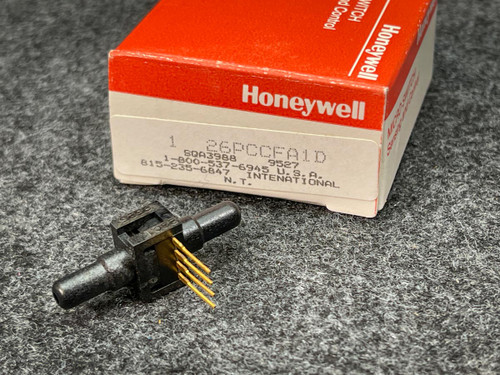
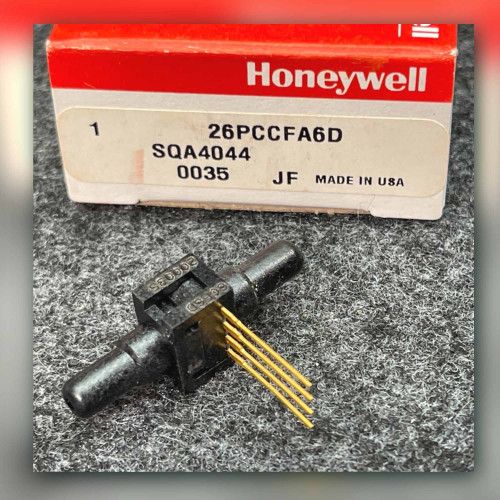
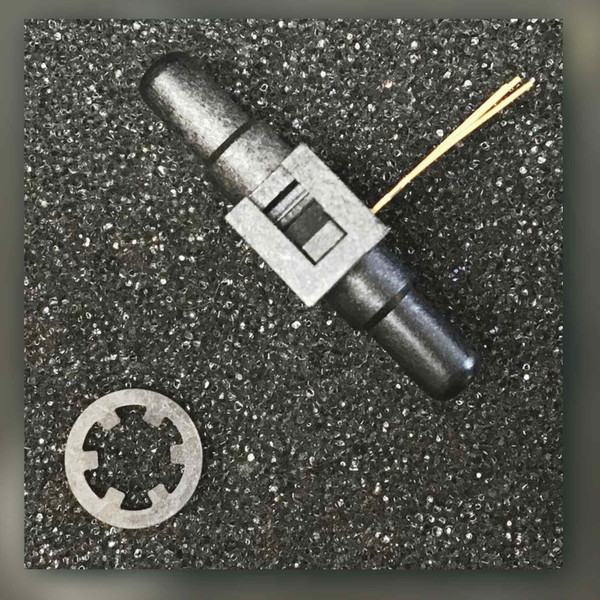
Unused, New Old Stock. The photographed sample is representative of our stock: a black molded body with the two pressure ports on a common axis, gold-plated straight leads that read bright and free of oxidation or solder, with no bench marks on the case. The leads lie nearly end-on and overlapping in that frame, so the 1 x 4 row is the Style 6 termination decoded from Honeywell's branding scheme rather than something you can count in the photo. A black finish steel lockring sits beside it in the first photo. Photos 2 through 5 reproduce Honeywell's PK 80083 installation sheet, Issue 1, for your reference. Honeywell's own warning on that sheet still applies: these sensors are not to be used as safety or emergency stop devices.
Same or next business day shipping from our Idaho warehouse. Honest pricing, no nonsense.
Online since 1999. We are here for our customers, with a no-hassle satisfaction guarantee.
Product Overview
The 26PCAFA6D is a low-range differential unit from Honeywell's 26PC Series, a family the PK 80083 sheet describes as four active element piezoresistive bridges: apply pressure, the bridge resistance shifts, and the sensor puts out a low-level differential voltage proportional to the pressure between port P2 and port P1. There is no amplifier inside, so the output goes to your own instrumentation amp or signal conditioner. Read against the 26PC laser branding scheme printed on the sheet shown here, the suffix decodes to a 1 psi range (A), a fluorosilicone media seal (F), Port Style A straight ports, Style 6 termination (the 1 x 4 straight lead row) and D for differential measurement. Photo 5 is the matching page of the sheet, titled for the differential sensor with 1 x 4 Style 6 termination and Port Style A straight ports only, which is exactly the part in front of the camera. The whole device weighs 2 grams.
Key Features
- Range: 1 psi differential, range code A on the 26PC branding scheme
- Sensing element: four active element piezoresistive bridge, unamplified millivolt output
- Excitation: 10 VDC typical, 16 VDC maximum per Honeywell's published performance table
- Input resistance: 5.5k ohm minimum, 7.5k ohm typical, 11.5k ohm maximum
- Output resistance: 1.5k ohm minimum, 2.5k ohm typical, 3.0k ohm maximum
- Response time: 1.0 ms maximum
- Operating temperature: -40 C to +85 C; compensated range 0 C to +50 C; storage -55 C to +100 C
- Ruggedness: shock qualification tested to 150 g, vibration to MIL-STD-202 Method 213
- Termination: 1 x 4 straight leads, Style 6, pin 1 notched
- Ports: Port Style A, straight, both ports on one axis
- Media seal: fluorosilicone (F)
- Weight: 2 grams
Applications
- HVAC technician building a filter loading monitor that has to see a fraction of a psi across a duct
- Instrumentation engineer prototyping a hydrostatic liquid level gauge on a small tank and conditioning the bridge output on the same board
- Automation builder putting together a low flow test bench where differential across an orifice is the measured value
- Maintenance electrician replacing a failed 26PC on legacy equipment and needing the same 1 x 4 straight footprint rather than a redesign
Frequently Asked Questions
Does this sensor need an external amplifier, and what is the pin order?
Yes, it needs one. The 26PC output is a low-level bridge voltage, not a conditioned signal. Honeywell's PK 80083 sheet gives the termination as pin 1 = Vs (+), pin 2 = output (+), pin 3 = ground (-), pin 4 = output (-), with pin 1 notched and pin 2 next to it. A pinout is the one figure worth confirming against current Honeywell documentation for your exact build before you commit a board layout.
What does the D at the end of 26PCAFA6D mean?
Differential. The sheet separates gage sensors, which measure against ambient, from differential sensors, which put out a voltage proportional to P2 minus P1 across the two ports. This is the differential version, so both ports do work and both need a plumbed connection.
What media can I run through it?
The F in the part number is Honeywell's fluorosilicone media seal. The installation sheet does not print a compatibility list and instead points you to Honeywell's catalog for media compatibility, so check your fluid or gas against that data before you plumb it. For cleaning, Honeywell recommends alcohols or fluorinated solvents and says not to immerse the sensor.
Is the steel lockring part of the deal?
One black finish steel lockring is shown next to the sensor in the first photo, and the PK 80083 sheet lists that ring as accessory PC-10182, supplied with Port Style A, 1 x 4 terminal sensors. We photographed one sample, not the whole shelf, so if a lockring is essential to your install please ask us to confirm before ordering rather than assume it.
Can I buy just one or two?
Yes. A 1 psi differential sensor is something you need one or two of, not fifty. We have a modest shelf quantity and you take the count your build actually calls for, one for the prototype or a few for spares. Shipping is $8 flat rate and free once your order passes $28, and orders leave our Idaho warehouse the same or next business day.
Two grams of silicon bridge, quietly turning a puff of pressure into a few millivolts, and Honeywell built it to be the part you stop thinking about the day it goes in. Give it a clean amplifier and a clean tubing run, and let it go back to minding your level, your filter, or your flow.