

Product Overview
Honeywell 26PC Series 15 PSI Differential Pressure Sensor, Unused in the Micro Switch Box
Condition
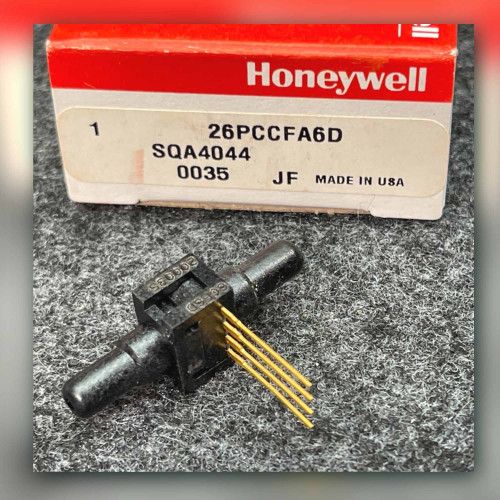
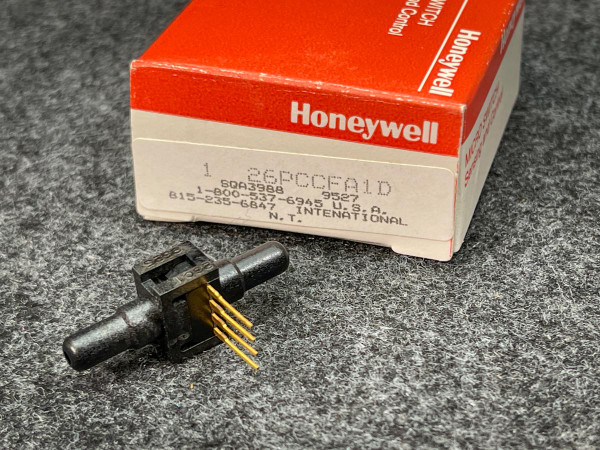
Unused, New Old Stock. The photographed piece is shown with its own red and white Honeywell box, still carrying the older MICRO SWITCH Sensing and Control branding. The box label reads 1 26PCCFA1D, SQA3988, 9527. On the sensor itself the gold-plated straight pins are bright, unbent and free of solder, and both straight ports are the smooth barbless style with the molded retention bead intact, clean and unmarked with no tubing scuffs. The last four images are scans of the Honeywell PK 80083 installation instruction sheet, shown for reference only; no printed sheet ships with the sensor. What is pictured is what defines the sale: the sensor as photographed. The PC-10182 steel lockring listed as an accessory on the instruction sheet is not shown in the photos and is not part of this listing.
Same or next business day shipping from our Idaho warehouse. Honest pricing, no nonsense.
Online since 1999. We are here for our customers, with a no-hassle satisfaction guarantee.
Product Overview
The 26PCCFA1D is a miniature board-mount differential pressure sensor from Honeywell's 26PC Series, rated for 15 psi and built around a four active element piezoresistive bridge that changes resistance as pressure is applied. It is unamplified: the output is a low-level millivolt bridge signal that scales with the excitation supply, with factory temperature compensation and calibrated null and span, so it wants a ratiometric reference downstream rather than a fixed one. The photos show the true dual-port differential body, one straight port on each side of the case, with the pressure differential taken as P2 minus P1. The PK 80083 instruction sheet scanned in the reference photos gives 10 VDC typical excitation (16 VDC maximum), 1.0 ms maximum response time, 5.5k to 11.5k ohm input resistance, 1.5k to 3.0k ohm output resistance, a 2 gram weight, and a straight Port Style A body on a 1 x 4 pin termination. The same sheet's branding key lists F as a fluorosilicone media seal and D as differential measurement, with the range table putting the C letter at 15 psi. Also sold and searched as Honeywell Micro Switch 26PCCFA1D and 26PC series 15 psi differential sensor.
Key Features
- Pressure range: 15 psi differential
- Sensing element: four active element piezoresistive bridge
- Output: unamplified low-level millivolt bridge, ratiometric to supply voltage
- Calibration: factory temperature compensated with calibrated null and span
- Excitation: 10 VDC typical, 16 VDC maximum (per PK 80083 sheet)
- Response time: 1.0 ms maximum (per PK 80083 sheet)
- Input resistance: 5.5k to 11.5k ohm; output resistance: 1.5k to 3.0k ohm
- Operating temperature: -40 C to +85 C; compensated 0 C to +50 C
- Media seal: fluorosilicone, for wet or dry non-corrosive media
- Ports: two straight barbless ports with retention bead, Port Style A, not threaded, true wet/wet differential sensing
- Termination: 1 x 4 straight through-hole pins, pin 1 notched
- Weight: 2 grams (per PK 80083 sheet)
Applications
- Instrument technician rebuilding a filter differential monitor and needing the original 15 psi wet/wet element rather than a modern amplified substitute
- Irrigation controls builder measuring head pressure across a screen filter with tubing run to both straight ports
- Design engineer prototyping a liquid level or flow board who wants a ratiometric bridge feeding an ADC that shares the same reference
- Automation shop keeping a legacy pneumatic test stand alive where the board was laid out around the 26PC footprint
Frequently Asked Questions
What is the pinout on the four pins?
The PK 80083 sheet shown in the reference photos gives pin 1 = Vs (+), pin 2 = Output (+), pin 3 = Ground (-), pin 4 = Output (-). Pin 1 is notched, and pin 2 is next to pin 1.
Is the output amplified?
No. This is an unamplified sensor putting out a low-level millivolt bridge signal, so it needs external amplification. Because the output tracks the excitation supply, pair it with a ratiometric reference for stable psi or kPa readings.
Which port is which on a differential reading?
Per the instruction sheet, the differential output is proportional to P2 minus P1: as that difference rises the differential voltage rises, and as it falls the voltage falls. Both ports are the straight style shown in the photos.
Anything to watch when soldering it in?
The sheet limits soldering to 315 C (600 F) maximum for 10 seconds maximum, and warns against immersing the sensor when cleaning. Honeywell also states these are not to be used as safety or emergency stop devices.
Why buy one or two sensors here instead of a bulk lot elsewhere?
Because a differential monitor usually needs one sensor, not a tray of ten. PartsMine sells the exact quantity you need for the repair or the prototype instead of forcing a minimum lot. Shipping is $8 flat rate and free over $28, and orders go out same or next business day from Idaho.
Two grams of piezoresistive silicon, still boxed under a brand name and an 815 phone number that Honeywell retired years ago. Give it a steady excitation supply and a matched reference, and it will go right back to splitting the difference between P1 and P2 for you.