

Product Overview
Trompeter 14949-PL20-1 Cable Group 1 RG-58 Coax Male Cable Termination
Condition
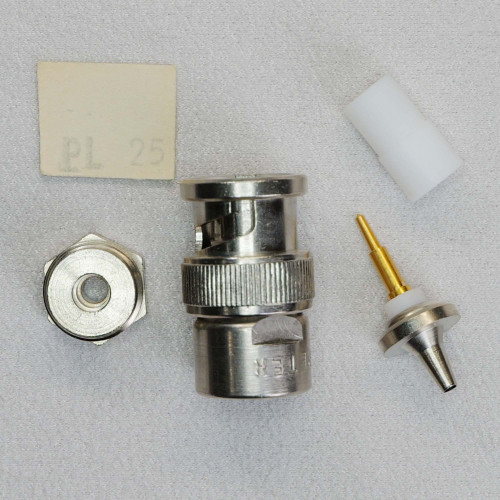
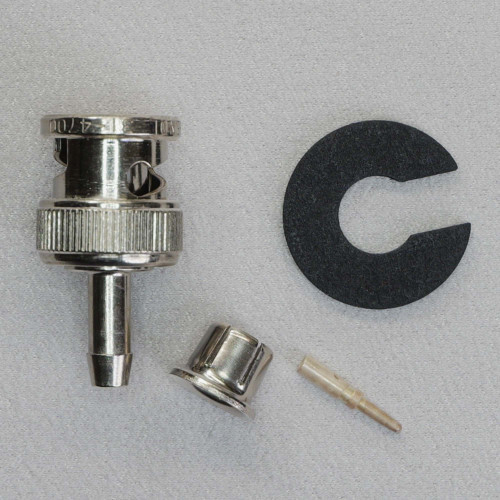
New old stock (NOS) in unused condition. Bright nickel plating with clean threads and gold-plated contact pin. Markings stamped on barrel: 14949 PL20-1. Includes connector body, contact cone assembly, clamp nut, and printed assembly instruction sheet TAI-101.
Ships same or next business day from our Idaho warehouse. Honest pricing, no nonsense.
Online since 1999. We are here for our customers, with a no-hassle satisfaction guarantee.
Product Overview
Trompeter Electronics PL20-1 (TEI 14949-PL20-1) is a 50-ohm straight BNC male plug engineered for Cable Group 1 flexible coaxial lines such as RG-58, RG-58A, RG-58C, and RG-141. The wrench-crimp design uses a threaded rear clamp nut to secure the braid against the internal cone assembly while the center conductor solders directly to the gold-plated contact pin.
Key Features
- Series: BNC male (plug) with standard two-stud bayonet coupling
- Impedance: 50 ohms
- Frequency range: DC to 4 GHz
- Compatible cable group: Trompeter Group 1 (RG-58, RG-58A, RG-58C, RG-141)
- Termination type: Mechanical wrench-clamp braid with solder center contact
- Construction: Machined brass body with nickel plating and gold-plated pin
Applications
- Terminating test leads and patch cables for bench oscilloscopes, signal generators, and spectrum analyzers
- Building or repairing 50-ohm amateur radio interconnects and VHF/UHF antenna feed lines using RG-58 coax
- Restoring legacy avionics, broadcast video lines, or industrial instrumentation requiring CAGE 14949 BNC terminations
Frequently Asked Questions
What tools are required to install this connector?
Assembly requires standard wire stripping tools, a soldering iron for the center pin, and standard open-end wrenches to tighten the clamp nut into the body assembly.
What coaxial cables work with Cable Group 1?
Trompeter Cable Group 1 accommodates RG-58, RG-58A, RG-58C, and RG-141 flexible 50-ohm coaxial cables.
How does a wrench-crimp connector differ from standard hex-crimp plugs?
Wrench-crimp connectors compress the braid mechanically against an internal cone using a threaded rear clamp nut, eliminating the need for specialized ratcheting crimp frames and interchangeable dies.
Field-service coax work was always simpler when all you needed in your kit was a soldering pencil and a pair of open-end wrenches. Thread it down, seat the braid, and get back on the air.