

Product Overview
50-Ohm RF Coaxial Cable Termination Plug with Gold Contact and Crimp Ferrule
Condition
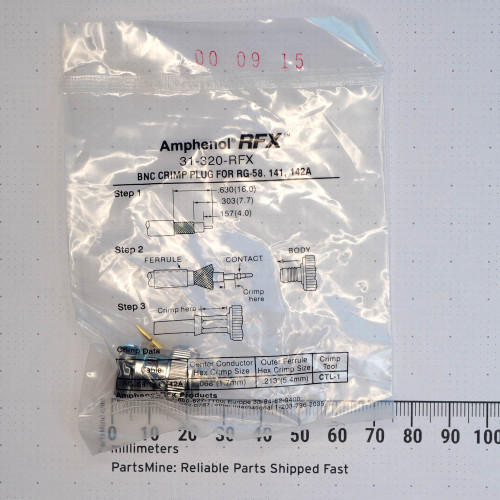
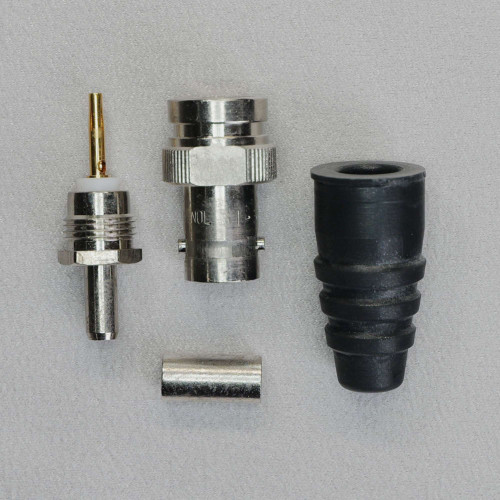
Unused new old stock (NOS). Sold each. Three-piece assembly includes the connector body, gold-plated center pin, and crimp ferrule. Collar stamped 36775.
Same or next business day shipping from our Idaho warehouse. Reliable parts since 1999. Honest pricing, no nonsense.
A no-hassle satisfaction guarantee on every order.
Product Overview
Amphenol 36775 is a straight 50-ohm BNC male RF coaxial connector engineered for cable-crimp termination on RG-58, RG-141, and LMR-195 coaxial lines. Designed for RF and test bench applications operating from DC up to 4 GHz, this three-piece connector features a nickel-plated brass body, a gold-plated center pin contact, and a PTFE dielectric insulator for stable impedance matching.
Key Features
- Connector type: Straight BNC male plug
- Impedance: 50 Ohm
- Frequency range: DC to 4 GHz
- Cable compatibility: RG-58, RG-141, LMR-195
- Termination style: Crimp body and pin
- Dielectric material: PTFE
- Contact plating: Gold-plated center pin
- Body material: Nickel-plated brass
Applications
- Building custom 50-ohm RF test leads and oscilloscope patch cables at the bench.
- Terminating field coax runs for amateur radio transceivers, antenna tuners, and SDR front ends.
- Repairing damaged BNC cable ends on signal generators, frequency counters, and laboratory instrumentation.
Frequently Asked Questions
Does this connector require a specialized crimp tool?
Proper termination requires a standard hex crimp tool sized for RG-58 coax and BNC center pins.
What impedance is this connector rated for?
This is a 50-ohm BNC connector with a PTFE dielectric, rated for operation up to 4 GHz.
What cable types fit the crimp ferrule on this connector?
The connector and crimp ferrule are dimensioned for RG-58, RG-141, and LMR-195 coaxial cable.
Good coaxial connections don't call attention to themselves; they just pass clean signal and lock in with a solid quarter turn. Crimp on your lead, bayonet it home, and get back to reading clean waveforms.