

Product Overview
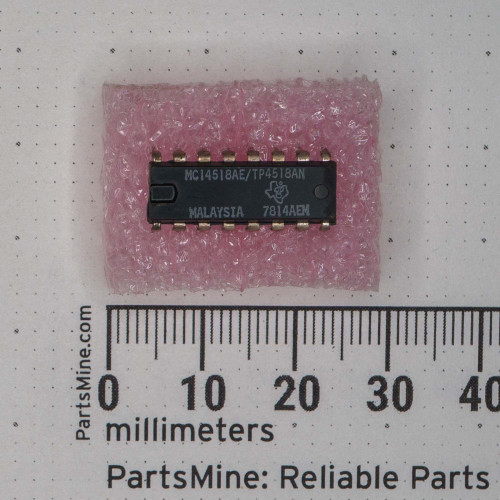
Texas Instruments SN7447N TTL BCD-to-7-Segment Decoder / Driver IC DIP-16
Condition
Unused new old stock (NOS). Markings legible: Texas Instruments logo, SN7447N. Straight factory pins with clean body molding.
Ships same or next business day from our Idaho warehouse. Honest pricing, no nonsense.
Online since 1999. We are here for our customers, with a no-hassle satisfaction guarantee.
Product Overview
Texas Instruments SN7447N BCD-to-7-segment decoder and driver in a standard 16-pin plastic dual in-line package (DIP-16). Designed to accept 4-bit binary-coded decimal inputs and drive common-anode 7-segment LED displays directly via active-low open-collector outputs.
Key Features
- Standard TTL logic family operating from a nominal 5.0V supply
- Active-low open-collector outputs rated up to 15V breakdown voltage
- 40 mA low-level output sink current capacity per segment
- Includes Lamp Test (LT), Blanking Input / Ripple-Blanking Output (BI/RBO), and Ripple-Blanking Input (RBI) functions
- Standard 16-pin dual in-line package (DIP-16) with 0.1-inch lead spacing
Applications
- Bench repair and restoration of vintage test equipment, frequency counters, and digital panel meters
- Retro computing and vintage arcade board logic repairs
- Driving common-anode LED digital displays in hobby breadboards and microcontroller projects
Frequently Asked Questions
Does the SN7447N require external current-limiting resistors?
Yes. The open-collector outputs sink current from an external voltage rail through the display segments, requiring series current-limiting resistors sized for your display voltage and desired LED current.
Can this IC directly drive common-cathode displays?
No. The SN7447N features active-low outputs designed specifically for common-anode displays. Common-cathode displays require an active-high driver such as the 7448.
What display segments does one SN7447N chip drive?
One chip provides the seven outputs needed to decode and drive a single numeric 7-segment digit. Multi-digit readouts require one decoder per digit.
Few things capture the classic glow of early digital electronics quite like a 7447 pulling current through vintage common-anode red LED digits. Drop it into your socket, tie the lamp test high, and watch the segments snap right into line.