

Product Overview
Phoenix Contact MCR-1CLP-I/I-00: A Passive Isolator That Runs On The Loop It Protects
Condition
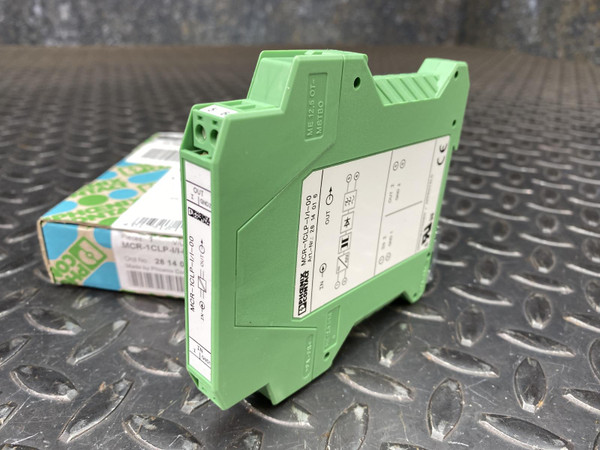
This module is cataloged New. In the photos the green Phoenix Contact case is clean and the printing is crisp on all three labels: the front panel with the type designation and terminal map, the side panel with the full spec block, and the bottom strip reading Nr. 2814016 with a 09.07.2015 date. The screw heads on the output terminal block, terminals 5 and 6, show no driver marks in these photos; the input block at terminals 1 and 2 is never resolved close up in any frame, so its screws cannot be read either way. The metal DIN rail foot is straight and unmarked. It is shown with its original Phoenix Contact carton, whose end label reads Pieces 1, MCR-1CLP-I/I-00, Ord. No. 28 14 01 6, Made by Phoenix Contact in Germany, and carries the same 09.07.15 date as the module. The carton was opened and the module lifted out so these photos could be taken.
Same or next business day shipping from our Idaho warehouse. Honest pricing, no nonsense.
Online since 1999. We are here for our customers, with a no-hassle satisfaction guarantee.
Product Overview
The MCR-1CLP-I/I-00 is Phoenix Contact's passive current loop isolator, order number 2814016, and its own side label states the job in two languages: Passiv Trenner / Loop Powered Isolator. It takes every bit of energy it needs from the measuring loop, so there is no 24 V supply to find and no auxiliary terminals to land. Current enters at terminals 1 and 2, marked IN I and GND 1, and leaves galvanically separated at terminals 5 and 6, marked OUT I and GND 2. The printed specs are 0 to 20 mA in and 0 to 20 mA out, a maximum of 50 mA and 30 V on the input side and 50 mA and 27.5 V on the output side, accuracy better than 0.1 percent plus under 0.02 percent per 100 ohms, a maximum load of 1000 ohms, a 70 Hz point at -3 dB, 500 V AC test voltage, and an operating range of -20 to +65 C. The cost of a passive design is loop headroom, and the label is honest about it: the printed equation allows up to 2.5 V of drop across the isolator, which the signal source has to supply on top of everything else on the loop. The case is Phoenix Contact's narrow 12.5 mm ME style with a metal DIN rail foot, screw terminal blocks top and bottom, and cULus and CE marks printed in the approvals panel.
Key Features
- Marked MCR-1CLP-I/I-00, Art.-Nr. 28 14 01 6, Phoenix Contact order number 2814016
- Passive loop powered isolator per the label: no supply voltage required
- Input 0 to 20 mA, maximum 50 mA, maximum 30 V
- Output 0 to 20 mA, maximum 50 mA, maximum 27.5 V
- Accuracy under 0.1 percent, plus under 0.02 percent per 100 ohms
- Maximum load 1000 ohms
- -3 dB frequency 70 Hz
- Test voltage 500 V AC
- Operating temperature -20 to +65 C
- Maximum voltage drop across the isolator of 2.5 V per the label equation
- Terminals 1 IN I and 2 GND 1 in, 5 OUT I and 6 GND 2 out, screw clamp
- cULus and CE marks printed on the approvals panel
- Narrow 12.5 mm ME housing with metal DIN rail foot
- Module and carton both dated 09.07.2015; carton states made by Phoenix Contact in Germany
Applications
- A panel builder dropping one 12.5 mm module onto a crowded DIN rail to break a ground loop between a field transmitter and a PLC analog input card, without hunting for a spare 24 V terminal.
- An instrument tech chasing a wandering reading on a long current loop between a tank junction box and the control room, where the two ends sit on different grounds.
- A machine builder isolating a drive's analog current output from a customer's monitoring system so two separately grounded cabinets stop arguing over a common.
- A test bench where a current source and a data logger have to stay separated, and the 1000 ohm load limit and 70 Hz response are comfortably inside what the measurement needs.
Frequently Asked Questions
Where do the specs in this listing come from?
Off the module itself. Phoenix Contact prints the full data block on the side of the case, and everything quoted here is read from it: 0 to 20 mA in and out, 50 mA and 30 V maximum on the input, 50 mA and 27.5 V maximum on the output, accuracy under 0.1 percent, 1000 ohm maximum load, 70 Hz at -3 dB, 500 V AC test voltage, and -20 to +65 C. Anything past the label, such as long term drift, isolation rating beyond that test voltage, or terminal torque, is not confirmed here. Verify against the datasheet before use.
Will it work in a standard 4-20 mA loop?
The label is marked 0 to 20 mA on both sides, and that range contains the 4 to 20 mA span every process loop uses. Headroom is the thing to check, not the range: because the isolator draws its power from the loop, the printed equation allows up to 2.5 V of drop across it, and your source has to have that to give on top of the burden of the receiver and the wiring. Passive means no power supply, not free.
Is this part 277-4870-ND or 2814016?
Both point at the same module. MCR-1CLP-I/I-00 is the Phoenix Contact type designation printed on the module, 2814016 is Phoenix Contact's own order number, shown on the case as Art.-Nr. 28 14 01 6 and on the carton as Ord. No. 28 14 01 6. The 277-4870-ND number is a distributor catalog number, not a manufacturer number. Search on whichever one your drawings or purchase history use.
Why buy this one module instead of taking a chance on a surplus lot?
Because there is one of these, it is the one in the photos, and you can read it before you spend anything: type designation, order number, the whole spec block, and a matching 2015 date on both the module and its carton. A mixed lot of signal conditioners is a gamble on which channel types and which ranges actually show up in the box, and a passive current-to-current isolator is a specific thing, not a generic one. Here you get the exact module photographed from several sides, with its original carton. This one clears our free shipping line on its own, and orders leave our Idaho warehouse the same or next business day.
A passive isolator asks nothing of your cabinet but about two and a half volts of loop headroom: no supply, no fuse, no terminal it did not already need. If two grounds are putting a wobble in a current reading somewhere in your plant, this one clips onto the rail and quietly ends the argument.