
Product Overview
0.056 µF 100V Radial Dipped Film Capacitors
Condition
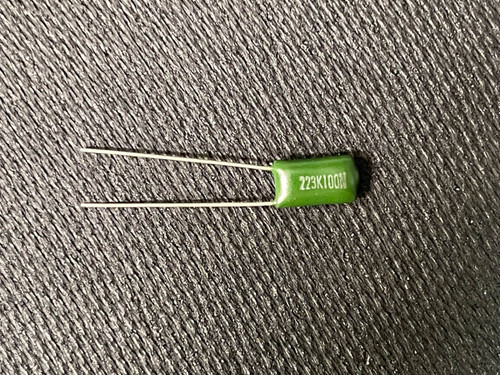
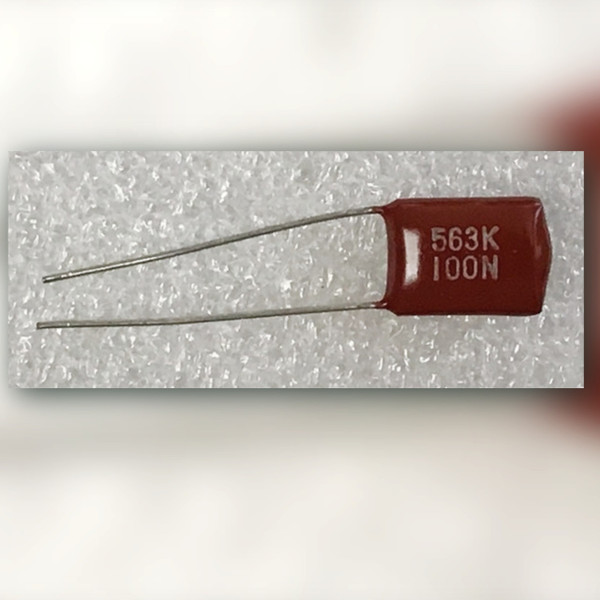
New old stock (NOS), unused inventory. Wire leads are clean, full-length, and untinned. Body markings read 563K over 100N.
Ships same or next business day from our Idaho warehouse. Honest pricing, no nonsense.
Online since 1999. We are here for our customers, with a no-hassle satisfaction guarantee.
Product Overview
This radial dipped film capacitor provides 0.056 µF (56 nF or 56,000 pF) of capacitance with a 100-volt rating. Encapsulated in a protective dark reddish-brown epoxy dip with radial through-hole leads, it serves as a stable component for audio tone shaping, bypass filtering, and signal coupling.
Key Features
- Capacitance: 0.056 µF (56 nF / 56,000 pF)
- Tolerance: ±10% (K code)
- Voltage Rating: 100 V
- Package: Radial dipped epoxy coating
- Termination: 2-pin radial through-hole wire leads
- Markings: 563K over 100N
Applications
- Dialing in tone control and bass-bleed networks in guitar electronics
- Servicing audio amplifier tone stacks and signal coupling stages
- Constructing analog active and passive timing filters on prototype boards
Frequently Asked Questions
What do the markings 563K and 100N represent?
The 563 marking represents 56 followed by 3 zeros in picofarads, equaling 56,000 pF (0.056 µF or 56 nF). The letter K designates a ±10% tolerance, and 100N indicates the 100 V rating.
Can this capacitor be used across AC power lines?
No. This capacitor is rated for 100 V DC circuit applications and is not rated for mains-voltage AC line filtering.
Why buy individual counts here rather than a generic assortment kit?
Ordering the specific value needed eliminates paying for unused values in bulk grab bags. More pieces cost less each, and the price-break table on this page shows what each quantity costs. Orders ship for an $8 flat rate, qualify for free shipping at $28, and leave our Idaho warehouse the same or next business day.
A dependable little block of capacitance for when an analog circuit simply needs the right curve and no excuses. Plug it in, solder it down, and let the signal flow clean.