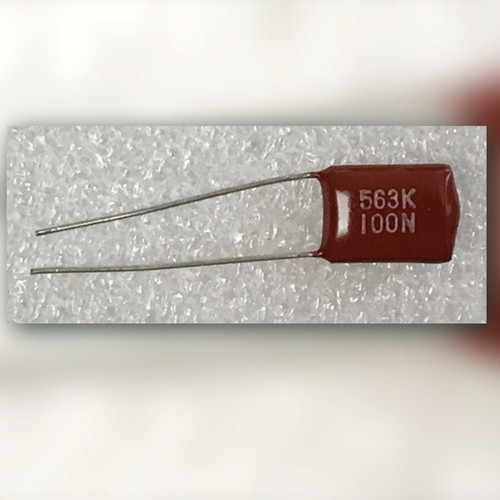


Product Overview
6800pF 100V Radial Film Capacitor, K Tolerance, Marked 682K100N, for Coupling, Filter and Timing Circuits
Condition
Unused new old stock (NOS). Markings legible: 682K100N. Dark green body with two straight, bright through-hole leads. Sold each.
Same business day shipping from our Idaho warehouse. Reliable parts since 1999. Honest pricing, no nonsense.
Satisfaction guaranteed, every time.
Product Overview
A 6.8nF (6800pF, 0.0068uF) radial-lead film capacitor rated 100V with +/- 10% tolerance, marked 682K100N on a dark green body. The whole spec reads off the printed code: 682 is 68 followed by two zeros in picofarads, K is the 10% tolerance letter, and 100 is the voltage rating. NOS stock for repair benches, kit builders and anyone matching a 6.8nF value on a through-hole board.
Key Features
- Capacitance: 6.8nF / 6800pF / 0.0068uF, from the EIA code 682
- Tolerance: +/- 10%, from the letter K
- Voltage rating: 100V
- Film capacitor, non-polarized
- Radial wire leads for through-hole mounting
- Dark green body, white printed marking 682K100N
Applications
- Swapping out a cracked or drifted 6.8nF coupling cap on an audio or signal board during a bench repair
- Setting the corner of an RC filter or tone network when building or modding a guitar pedal or preamp
- Pairing with a resistor for an RC timing or snubber network on a low-voltage control board
- Stocking a parts drawer with a common small-value film cap for breadboard and perfboard projects
Frequently Asked Questions
Does it matter which way the leads go in?
No. Film capacitors are non-polarized, so either lead can go to either pad.
Can it run in a circuit that sees less than 100V?
Yes. 100V is the rating ceiling. It works at any working voltage below that, including 5V, 12V and 24V logic and audio circuits.
Does 682 mean 682 nanofarads?
No. The 682 is a picofarad code: 68 followed by two zeros, which is 6800pF, the same as 6.8nF or 0.0068uF. More pieces cost less each - the price-break table on this page shows what each quantity costs.
Everything this little green cap knows about itself fits on one printed line, and 6.8nF is the kind of value that quietly decides where a filter starts to roll off. Solder it in and let the circuit do the talking.