

Product Overview
0.027 µF 100 VDC Non-Inductive Polyester Mylar Film Capacitors
Condition
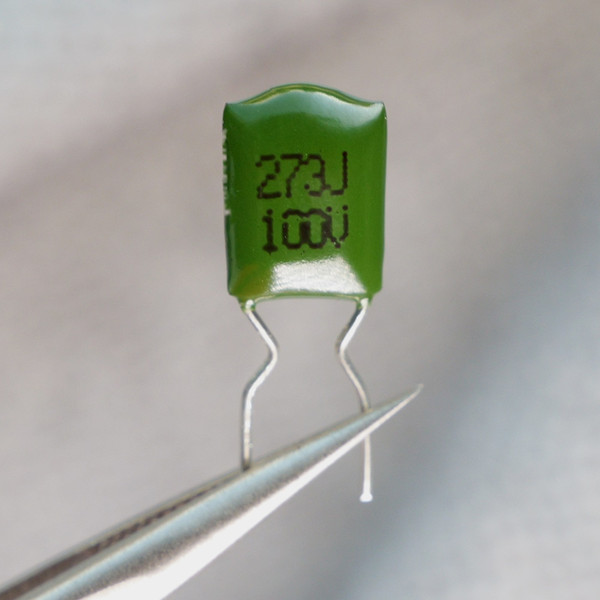
Unused new old stock (NOS) in clean surplus condition. Marked 273J 100V with clean crimped wire leads and intact green epoxy coating. Stored in dry facility stock.
Same or next business day shipping from our Idaho warehouse. Reliable parts since 1999. Honest pricing, no nonsense.
We are here for our customers, with a no-hassle satisfaction guarantee.
Product Overview
The 273J100V is an epoxy-dipped radial polyester (Mylar) film capacitor rated for 0.027 µF (27 nF) at 100 VDC with a ±5% tolerance. Built with formed standoff leads for standard 5.0 mm through-hole circuit board mounting, it provides stable capacitance in audio filtering, bypass networks, timing circuits, and instrument controls.
Key Features
- Capacitance: 0.027 µF (27 nF / 27,000 pF)
- Working voltage: 100 VDC
- Tolerance: ±5% (J code)
- Dielectric: Polyester film (Mylar)
- Lead configuration: Radial formed wire leads with crimped standoffs
- Lead pitch: 5.0 mm spacing
- Epoxy-dipped moisture-resistant outer coating
Applications
- Tone control circuits for electric guitars and bass preamps
- Audio crossover networks, synthesizer filters, and equalizers
- Signal filtering, timing circuits, and pulse-forming networks in analog test gear
- General bench repair, prototype breadboarding, and maker electronics projects
Frequently Asked Questions
What does the 273J marking indicate?
The marking code 273 indicates 27,000 pF, which equals 0.027 µF or 27 nF. The letter J specifies a ±5% capacitance tolerance.
Can this capacitor be used directly across AC mains power?
No. This is a 100 VDC general-purpose polyester film capacitor and does not carry safety ratings for direct connection across AC utility lines.
Why buy these capacitors individually from PartsMine?
Buying surplus stock here lets you purchase the exact number of components your repair or build requires without taking on a full wholesale pack or unverified surplus lot. More pieces cost less each, and the price-break table on this page shows what each quantity costs. Orders ship for an $8 flat rate, qualify for free shipping at $28, and ship from our Idaho warehouse the same or next business day.
Green dipped Mylar caps have voiced guitar tone stacks and analog synths for decades. Drop this one into your filter network and dial in the resonance your ear was waiting for.