

Product Overview
HP 1866 311 Hermetic Flange-Mounted Replacement Transistor
Condition
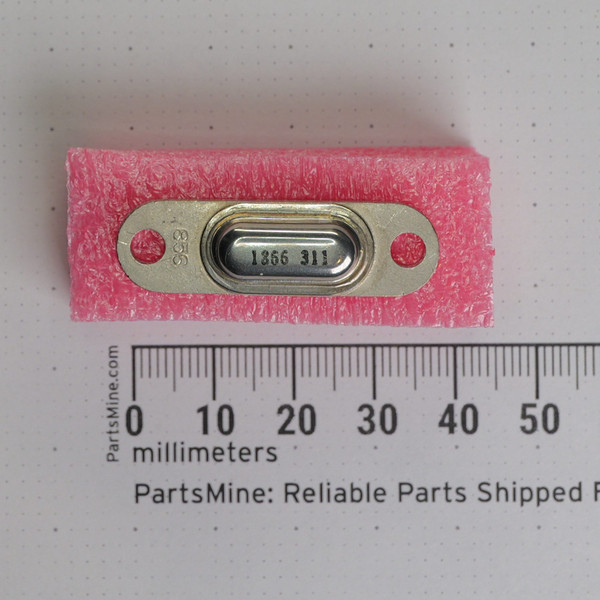
New old stock (NOS). Unused surplus component with clean, straight gold-plated lead pins. Markings legible: 1866 311. Underside terminals stamped with E and B designations.
Same or next business day shipping from our Idaho warehouse. Reliable parts since 1999. Honest pricing, no nonsense.
We are here for our customers, with a no-hassle satisfaction guarantee.
Product Overview
Hewlett-Packard 1866-0311 (marked 1866 311) is a discrete bipolar power transistor packaged in a hermetic two-hole flange-mount metal can. Sourced from vintage inventory, this component serves technicians and restorers maintaining classic HP precision instrumentation and legacy test gear. The package utilizes glass-to-metal hermetic seals on the emitter and base pins, with the metal flange acting as the collector connection.
Key Features
- Hewlett-Packard part number 1866-0311 with 1866 311 can marking
- Hermetically sealed metal can package with two-hole oval mounting flange
- Underside stamped E and B terminal designations for emitter and base
- Gold-plated through-hole lead pins with glass seals
- Common metal mounting flange collector terminal
- Flange length 33 mm with 24 mm mounting hole center spacing
Applications
- Restoring original performance on legacy Hewlett-Packard test equipment power supplies and amplifier sections
- Replacing open or shorted proprietary HP transistors in analog instrumentation chassis
- Servicing vintage audio, RF, or precision calibration equipment requiring authentic HP silicon
Frequently Asked Questions
Which pins correspond to the base and emitter?
The underside header is stamped with E and B directly adjacent to each glass-sealed pin. The metal flange and can body serve as the collector terminal.
What is the mounting hole spacing on the flange?
The mounting flange measures 33 mm in total length with 24 mm center-to-center spacing between the two screw holes.
Classic Hewlett-Packard equipment was engineered to last decades as long as you have the exact semiconductor to keep the circuit running. Drop this piece onto the heat sink and put an honest bench instrument back to work.