

Product Overview
Motorola N-Channel JFET in a Gold Lead Metal Can, New Old Stock Out of the Phoenix Blister Card
Condition
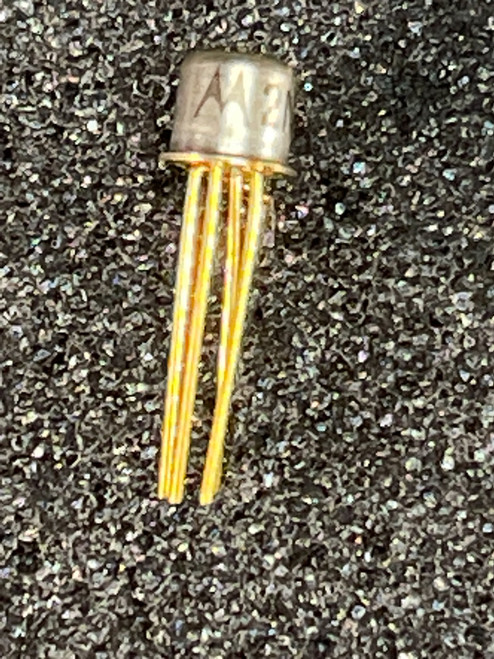
New old stock. The photographed piece is a small metal can with five gold plated leads: four splayed straight out from the header, plus a fifth short lead that is bent back roughly ninety degrees against the base of the can in every photo. The four straight leads are bright with no solder and no tinning; the fifth carries that bend and we are leaving it as found rather than straightening it. The can carries an ink marking that ends in 224; the character ahead of it sits on the curve of the can and is not legible in these photos, so we are not stating a full manufacturer part number. Plating tone varies across the can from bright to slightly darkened depending on the light, which is normal for a metal can device that has been on a shelf a long time. The stock came out of Motorola Semiconductors blister card packaging printed MADE IN USA, PHOENIX, ARIZONA, shown in the last photo. Six pieces on the shelf.
Same or next business day shipping from our Idaho warehouse. Honest pricing, no nonsense.
Online since 1999. We are here for our customers, with a no-hassle satisfaction guarantee.
Product Overview
This is a single N-Channel junction field effect transistor from Motorola, built as a through hole part in a small metal can rather than a plastic body. Minimum forward transconductance is 1000 uS. A JFET is a voltage controlled current source, or a voltage controlled resistor, with three terminals: gate, drain and source. The gate to source voltage controls the current flowing through the drain to source or drain to gate terminals. It is a very high impedance device, used as a voltage controlled resistor, as a buffer ahead of integrated circuit logic inputs, and as a gain controlled current source in amplifier circuits. Unlike a bipolar transistor it is not a dependent device, so it needs no direct current biasing. Worth noting from the photos: the can carries five gold plated leads alongside a three terminal device, and one of those five is bent back against the base of the can, so confirm which lead is which against the datasheet for whatever number you match this to before you wire it in.
Key Features
- Transistor polarity: N-Channel
- Configuration: single
- Mounting style: through hole
- Forward transconductance, minimum: 1000 uS
- Package, from the photos: small metal can with five gold plated leads, four straight and a fifth bent back against the can base; exact JEDEC outline not confirmed
- Brand: Motorola Semiconductors, card printed MADE IN USA, PHOENIX, ARIZONA
- Can marking: ends in 224, leading character not legible in the photos
- Condition: new old stock, six pieces available
Applications
- Instrument tech rebuilding a 1970s analog front end that needs a high impedance input stage instead of a modern plastic substitute
- Audio builder using a JFET as a voltage controlled resistor in a compressor, tremolo or gain cell
- Lab engineer setting up a gain controlled current source inside an amplifier chain
- Restorer matching a period correct gold lead metal can device on a board that originally carried one
Frequently Asked Questions
What exactly is printed on the can?
The visible marking ends in 224. The character in front of it wraps onto the curve of the can and is not readable in these photos, so we are not going to guess at it. What is confirmed is the brand, the N-Channel polarity, the single configuration, the through hole mounting and the 1000 uS minimum forward transconductance. Match the photos against your own reference and verify the full part number before you design it in.
Why does the can have five leads when a JFET has three terminals?
The photos show five gold plated leads on the can: four splayed straight out and a fifth short one bent back against the base of the can. Our record does not identify what the extra leads connect to, so treat the pinout as unconfirmed and check it against the datasheet for the device you match this to before wiring.
Is it usable in a modern build, not just a restoration?
Yes. A high impedance N-Channel JFET behaves the same in a new circuit as an old one, and the metal can package is easy to mount and easy to heatsink or shield. The one caution is the same as above: confirm the pinout and the ratings you need against a datasheet, because we are only stating what our record and the photos support.
Do the leads need cleaning before soldering?
Nothing in the photos suggests they would. The gold plating on all five leads is bright and unsoldered, with no corrosion and no old flux. Bear in mind that the fifth lead is bent back against the can base rather than straight, so plan for that if you are fitting this into an existing footprint. The can body shows tone variation from age, not the leads.
I only need two or three of these. Do I have to buy a lot?
No. There are six on the shelf and you take the count you need, one for a repair or a few if you want to pick a close pair for a differential front end. That is the whole point of buying here instead of bidding on a hundred piece surplus lot to get the three you will actually use, and these came off a Motorola blister card rather than out of an unmarked bulk bag. Shipping is a flat $8, free once your order passes $28, and orders leave the Idaho warehouse the same or next business day.
Gold leads and a Phoenix printed card put this one squarely in Motorola's metal can era, when a small signal JFET shipped on its own little square of cardboard. If you are rebuilding a high impedance front end and want the period correct device rather than a modern plastic stand-in, the next chapter is yours to write.