

Product Overview
5-Watt 2-Ohm Precision Wirewound Power Resistor with Heat Sink Fins
Condition
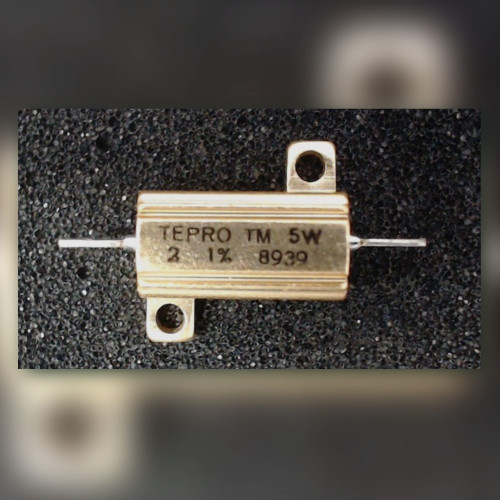
Sold each. Unused new old stock (NOS). Terminal lugs are clean and straight with factory tinning. Body markings legible: TEPRO TM 5W stamped on top face, 2 Ω 0.1% along the finned edge.
Same or next business day shipping from our Idaho warehouse. Reliable parts since 1999. Honest pricing, no nonsense.
We are here for our customers, with a no-hassle satisfaction guarantee.
Product Overview
Tepro TM series 5W wirewound resistor in an extruded black aluminum housing designed for direct chassis mounting. Engineered to MIL-R-18546 specifications for precision power dissipation, snubber circuits, and test equipment loads requiring a tight 0.1% tolerance.
Key Features
- 2 Ω resistance with a tight ±0.1% tolerance
- 5-watt power rating under MIL-R-18546 chassis-mounting conditions
- Black anodized aluminum housing with integrated cooling fins for thermal dissipation
- Two diagonally offset mounting flanges with through-holes for chassis attachment
- Axial flat solder lugs with through-holes for secure lead termination
Applications
- Current sensing and shunt calibration in precision low-voltage power supply benches
- Snubber and damping networks across switching relays or inductive loads in vintage audio amplifiers
- Constructing low-resistance dummy load terminations for radio frequency and audio frequency bench testing
Frequently Asked Questions
Does this resistor require mounting to a metal chassis to achieve its full 5-watt rating?
Yes. Aluminum-housed power wirewounds rely on direct surface contact with a metal chassis or heat sink to conduct heat away and safely sustain their full 5-watt rating.
What type of terminals are fitted on this component?
Both ends feature axial flat solder lugs with punched holes for securing and soldering lead wires.
Can this unit replace a standard axial wirewound resistor?
It can replace an axial resistor electrically, but physical installation requires mounting the flat finned housing to a chassis or panel and wiring to the pierced solder lugs.
When an ordinary power resistor drifts too far to trust, a tight tenth-of-a-percent wirewound in an aluminum heat sink is what brings stability back to the circuit. Bolt it down, solder the lugs, and let your bench run cool.