

Product Overview
Mallory MLCN55L 500K Ohm Potentiometer with Slotted Plastic Shaft and Bushing Mount
Condition
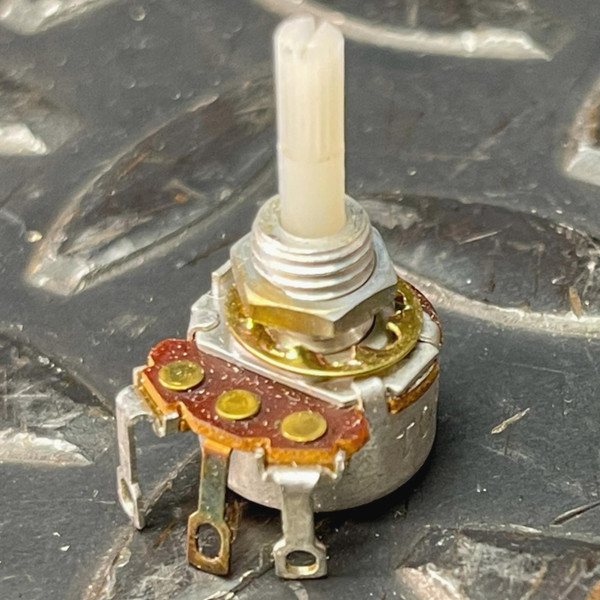
New. The three photographs show a clean plated metal can with a series marking embossed into the shell, reading as MLCN5 plus a partial character from the angle in the third photo. The white plastic shaft is slotted and unbroken, the threaded bushing still carries its hex mounting nut and a brass-colored lockwasher, and the three solder lugs on the red phenolic terminal wafer are bare and bright with no solder on them and no sign of prior wiring. Light surface tarnish and a few handling marks are visible on the can, the kind that comes from years in a parts drawer rather than from service. Supplied as a loose piece with no original bag or box. Three in stock.
Same or next business day shipping from our Idaho warehouse. Honest pricing, no nonsense.
Online since 1999. We are here for our customers, with a no-hassle satisfaction guarantee.
Product Overview
The MLCN55L is a Mallory panel potentiometer built the traditional way: a drawn metal can, a red phenolic terminal wafer, and a threaded cylindrical bushing that drops through a panel hole and clamps down with one hex nut. This piece is 500K ohm with taper code 4, and its terminals are radially positioned over less than half the circumference, which is exactly what the photos show - three gold-colored rivets grouped on one side of the wafer, each feeding a solder lug bent out for hand wiring. The shaft is white plastic rather than steel, so the knob end sits electrically isolated from the case and the chassis. We are not identifying the polymer from photographs. Shaft length, bushing thread and length, resistance tolerance, and power rating are not confirmed here - measure your panel and verify against the datasheet before you design this control in.
Key Features
- Resistance: 500K ohm
- Taper: code 4
- Marking: embossed into the metal can, reading as MLCN5 plus a partial character, with a separate H01 code on the opposite face; the Mallory name and full part number come from the catalog record, not from the case
- Mounting: cylindrical bushing mount, hex nut and lockwasher fitted in the photos
- Terminals: three solder lugs on a red phenolic wafer with gold-colored rivets, radially positioned over less than half the circumference
- Shaft: white plastic, slotted, non-conductive
- Condition: New, three pieces in stock
- Shaft length, bushing thread, tolerance and power rating: not confirmed - verify against the datasheet before use
Applications
- Vintage radio restorer replacing a scratchy 500K volume or tone control on a point-to-point chassis
- Guitar and hi-fi amp tech who needs a 500K panel control with an insulated shaft so the knob stays off the circuit
- Instrument repair shop rebuilding a front panel where the original bushing-mount control went out of production decades ago
- Bench builder wiring a one-off test box or attenuator and soldering straight to the lugs
Frequently Asked Questions
What markings are actually on the part?
The series marking is embossed into the metal can rather than printed, so it reads clearly only from the right angle. In the third photograph the embossing reads as MLCN5 plus a partial character along the side of the shell, and a separate H01 code is embossed on the opposite face, visible in the first and second photographs. The Mallory name itself is not embossed anywhere we can see. There is no paper label, no ink-stamped date code, and no resistance value printed on the body, so the 500K ohm value and the taper code come from the catalog record for this part rather than from the case.
What does taper 4 mean on this control?
Taper 4 is the taper designation carried in the original catalog data for this control. Taper codes are manufacturer-specific, and we have not confirmed which resistance curve Mallory assigned to code 4 on the MLCN55 series. If the curve matters to your circuit, treat it as unconfirmed and check it against a Mallory control catalog or measure it yourself once you have the part in hand.
The listing data mentions single pole, single throw, normally open - is there a switch on this potentiometer?
That wording comes from the original catalog record for this part and we have carried it forward unchanged. What the four photographs show is the plain round can with a red phenolic terminal wafer and three solder lugs, with no separate switch section visible on the back of the case. We are not confirming a switch from the photos alone. If a switched control is specifically what you need, message us before ordering and we will put hands on the actual piece.
Will a standard knob fit the plastic shaft?
The shaft is white plastic with a flat slotted profile, discernible in the two close-up photographs; at the distance of the ruler shot it reads as a plain smooth cylinder. It is intact with no chips at the tip. Shaft diameter and length are not confirmed here, so measure the knob you plan to use, or ask us for a measurement, before you count on the fit. The plastic does mean the shaft is non-conductive, which is useful on a live chassis.
Why buy this one photographed control instead of a surplus lot of mixed potentiometers?
Because you are buying a known piece rather than a gamble. Everything we can see about this control is in the photos above - the embossed can, the riveted phenolic wafer, the bare unsoldered lugs, the nut and washer still fitted - so you can match it against the hole in your panel before you order. A box lot or an auction pallet of pulled controls hides the scratchy ones at the bottom and rarely tells you a value, let alone a taper, and here there are only three pieces on the shelf. Shipping is $8 flat rate and free once your order passes $28, and orders leave our Idaho warehouse the same or next business day.
Mallory built controls for an era when a knob was the entire user interface - metal can, phenolic wafer, plastic shaft, nothing else needed. The lugs are still bare, so whatever panel you are bringing back gets a 500K that has never been wired to anything.