

Product Overview
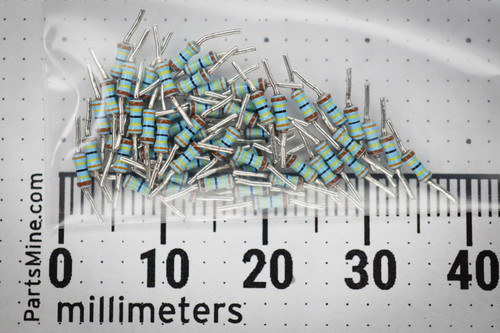
Vishay Dale RN55E6490FJ - 649 Ohm MIL-Spec Metal Film Resistor, 1% Tolerance, 25 ppm/°C, Through-Hole Axial
Condition
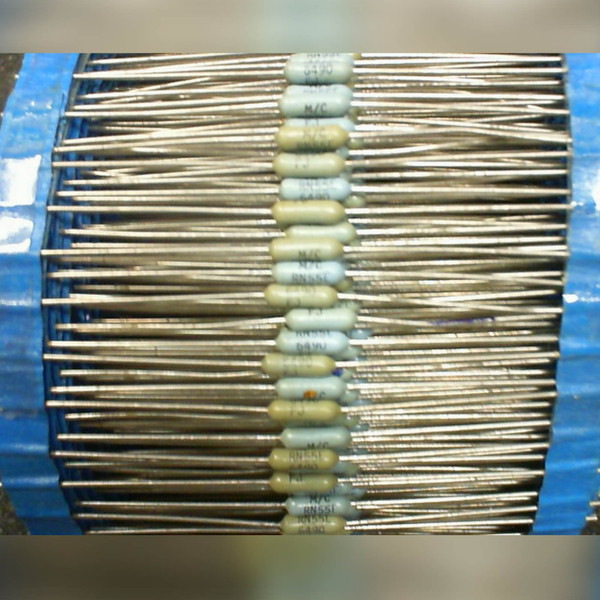
Unused NOS. Resistors are on original ammo tape. Bodies marked RN55E, M/C (military component grade), 6490, and FJ - markings legible across all units. Some discoloration due to age is present on the tape and bodies. Evaluation: Visual inspection only. Function testing not performed. Sourced from legacy electronics supply chain recovery.
Same business day shipping from our Idaho warehouse. Reliable parts since 1999. Honest pricing, no nonsense.
We are here for our customers, with a no-hassle satisfaction guarantee.
Product Overview
Vishay Dale RN55E6490FJ - a 649 Ohm axial metal film resistor qualified to MIL-R-10509/7. The RN55E designation locks in three critical performance parameters: 1% resistance tolerance, 25 ppm/°C temperature coefficient, and a 1/8W power rating. Manufactured to military component grade (M/C marking confirmed on bodies), these are through-hole axial parts suited for demanding analog circuits where resistance stability under temperature and load matters.
Key Features
- Resistance: 649 Ohms
- Tolerance: ±1%
- Temperature coefficient: ±25 ppm/°C
- Power rating: 1/8W (0.125W) at 70°C; derated to 1/10W (0.1W) at 125°C
- Maximum working voltage: 200V
- Military specification: MIL-R-10509/7
- Military component grade - M/C marking confirmed on bodies
- Form factor: axial-lead through-hole
- Alternating tan and gray-green body colors visible on tape - normal for this series
- Manufacturer: Vishay Dale
Applications
- Populating a phono preamplifier PCB or RIAA equalization stage - bending the axial leads to 0.3" or 0.4" centers, soldering into the input network where thermal noise and resistor drift translate directly into audible hiss under gain
- Replacing an out-of-tolerance resistor in legacy avionics, communications gear, or military test equipment - desoldering the original, cleaning the pads, and soldering in a MIL-R-10509-qualified replacement that meets the original schematic designation without a compliance exception
- Installing reference resistors in a voltage divider or analog feedback loop inside a precision instrument - allowing the circuit to reach thermal equilibrium and verify calibrated accuracy across the operating temperature range
- Audiophile and hi-fi DIY builds: headphone amplifiers, line-stage attenuators, or cartridge-loading networks where a 25 ppm/°C part keeps channel balance stable through warm-up
- Prototyping or restoring vintage test gear where the original BOM called for MIL-spec through-hole parts and a commercial substitute would introduce drift the design did not account for
Frequently Asked Questions
Is this the same part as the Vishay CMF55 series?
No. The RN55E series is qualified to MIL-R-10509/7 and carries the military component grade (M/C) marking. The CMF55 is the commercial equivalent and is not MIL-R-10509 qualified. For designs or repair orders that require a documented MIL-spec part, the RN55E is the correct choice. If MIL qualification is not a requirement, both parts share similar performance characteristics.
Will this work as a drop-in replacement for an RN55C6490 or RN55D6490?
The resistance value (649 Ohms) and power rating (1/8W) are identical across the RN55 series. The difference is the temperature coefficient: the RN55C is rated at ±50 ppm/°C and the RN55D at ±100 ppm/°C. This RN55E is tighter at ±25 ppm/°C. It is a drop-in replacement by resistance and package; the tighter tempco is an improvement, not a constraint.
What is the maximum power this resistor can handle?
1/8W (0.125W) at 70°C, derated to 1/10W (0.1W) at 125°C. Do not use this part in a circuit position rated for 1/4W or 1/2W - it will overheat and fail. Apply Ohm's law to confirm the actual dissipation in your circuit before installation.
Are the leads in soldering condition?
Parts are unused NOS on original ammo tape. Some discoloration due to age is noted. Lead condition was not individually evaluated. Standard practice for NOS through-hole parts is to lightly abrade or flux the leads before soldering if oxidation is visible.
A 649 Ohm resistor is a quiet workhorse - no one buys it for the glamour. But in an RIAA stage or a calibrated feedback loop, getting the tempco wrong by 75 ppm costs you channel balance and measurement drift. This one gets it right.