

Product Overview
100nF 200VDC Radial Polyester Dipped Component - 5% Tolerance
Condition
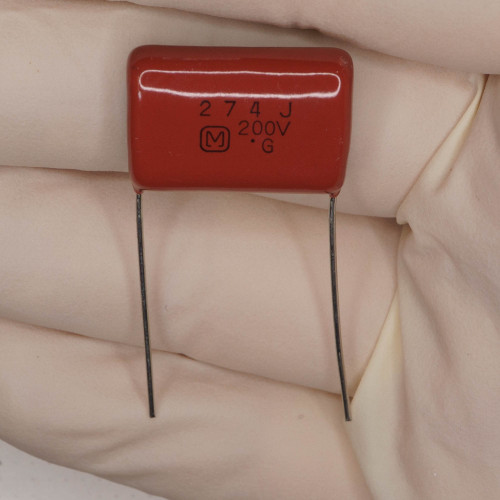
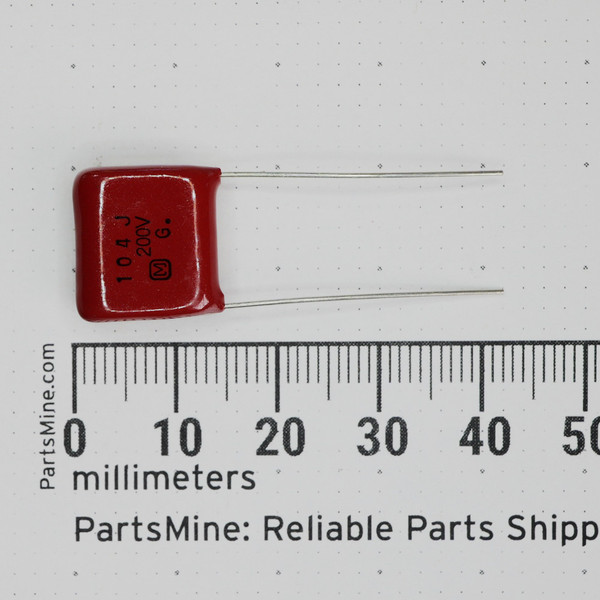
Unused new old stock (NOS). Clean, straight radial wire leads. Body markings legible: 104 J, 200V, Matsushita boxed M logo. Sold each.
Same or next business day shipping from our Idaho warehouse. Reliable parts since 1999. Honest pricing, no nonsense.
We are here for our customers, with a no-hassle satisfaction guarantee.
Product Overview
Panasonic ECQ-B2104JF radial film capacitor rated at 0.1 uF (100 nF) and 200 VDC with a 5% tolerance. Built with metallized polyester film and sealed in flame-retardant red epoxy dip, this discontinued ECQ series component provides reliable signal coupling, filtering, and pulse handling across audio gear, instrument power supplies, and analog timing circuits.
Key Features
- 0.1 uF capacitance (100 nF, marked 104)
- 200 VDC maximum working voltage
- ±5% tolerance (J code)
- Radial wire lead termination for through-hole PCB assembly
- Flame-retardant dipped red epoxy protective coating
- Discontinued Panasonic ECQ-B series passive component
Applications
- Bypassing and DC blocking in tube amplifier signal chains and solid-state audio restoration
- Rebuilding vintage synthesizer filters and analog oscillator voice boards
- Noise filtering and ripple suppression in linear DC bench power supplies
- Guitar pedal and tone control builds requiring durable 200V film caps
Frequently Asked Questions
What type of dielectric is used in the ECQ-B series?
The ECQ-B series uses polyester film dielectric with radial leads, sealed in an epoxy dip coating for moisture and temperature resistance.
Is this capacitor polarized?
No. Film capacitors are non-polarized components and can be inserted into a circuit in either direction.
What is the lead orientation on this package?
Straight radial wire leads exit from the base of the red dipped body for standard through-hole board mounting.
Solid Japanese film construction from an era when through-hole audio circuits were built to last decades. Slot it into your signal path and let the circuit sing.