

Product Overview
Intel i486DX 33MHz Microprocessor PGA-168 Bent Pins As-Is Scrap
Condition
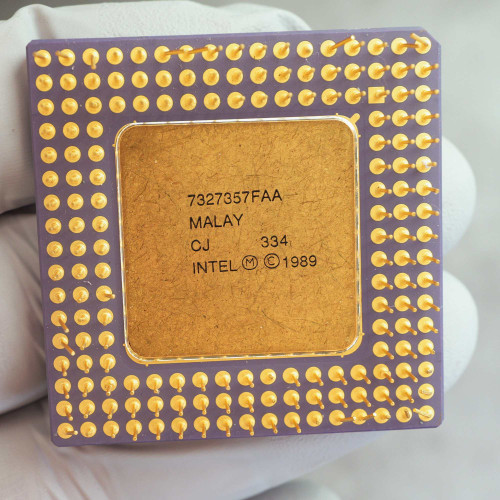
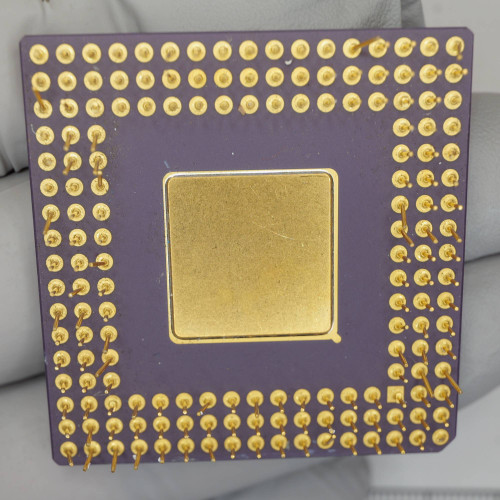
Used processor with bent pins along the outer perimeter of the pin grid array. Sold as-is for gold recovery, scrap, or vintage display. Markings legible: intel i486 DX, A80486DX-33, L3130979, SX729, INTEL (M)©1989 on the ceramic top; 93073463AA MALAY CC 313 on the underside gold lid. Evaluation: Visual inspection only. Function testing not performed.
Ships same or next business day from our Idaho warehouse. Honest pricing, no nonsense.
Online since 1999. We are here for our customers, with a no-hassle satisfaction guarantee.
Product Overview
Intel A80486DX-33 (sSpec SX729) 32-bit microprocessor built on 1.0 µm CHMOS technology in a 168-pin ceramic pin grid array. Features a 33 MHz operating frequency, 8 KB unified L1 cache, and an integrated floating-point math coprocessor. Offered strictly as scrap or for gold recovery due to physical pin damage.
Key Features
- 33 MHz core and bus frequency
- Integrated x87 floating-point math coprocessor
- 8 KB unified Level 1 code/data cache
- 5.0V nominal supply voltage
- 168-pin ceramic pin grid array (CPGA-168)
- Gold-plated pins and central gold-plated lid
Applications
- Precious metal and electronic scrap gold recovery
- Vintage computing display piece or tech artifact collection
- Pin straightening project for vintage Socket 1, 2, or 3 motherboard experimentation
Frequently Asked Questions
What is the physical condition of the pins on this CPU?
Multiple pins along the outer rows of the pin array are bent. Due to this physical damage, the processor is sold as scrap and has not been tested.
What does sSpec SX729 indicate for this part?
SX729 denotes an Intel i486DX-33 running at 33 MHz on a 5V core with 8 KB of internal cache in a CPGA-168 package.
What am I getting and what condition risks am I taking on with this processor?
This is an untested, used processor with bent pins sold strictly as-is for gold recovery, display, or parts. Functionality is unverified, and the buyer assumes full condition risk.
Before sub-micron dies and integrated heat spreaders ruled the desk, ceramic packages with real gold lids carried the 32-bit revolution. Whether this chip yields its gold or sits on a shelf as a silicon relic, its work is already part of computing history.