

Product Overview
20 V 1 A Schottky Barrier Rectifier, Axial DO-41, 0.45 V Forward Drop at Full Load
Condition
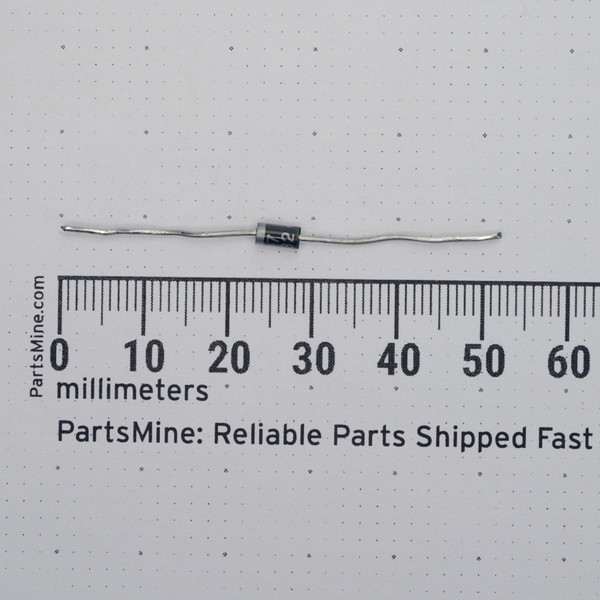
Condition: unused new old stock (NOS). Body marking partially legible: 5817. Gray cathode band at one end of the black body. Leads show bends and waves along their length, with uneven sheen on one lead. Sold each.
Ships same or next business day from our Idaho warehouse. Honest pricing, no nonsense.
Online since 1999. Satisfaction guaranteed, every time.
Product Overview
General Semiconductor 1N5817 Schottky barrier rectifier, rated 20 V and 1 A in the axial DO-41 package. Its low forward drop makes it a standard choice for low-voltage power paths, where a silicon rectifier would waste more of the supply as heat.
Key Features
- Maximum repetitive peak reverse voltage (VRRM): 20 V
- Maximum average forward rectified current: 1.0 A
- Maximum instantaneous forward voltage: 0.45 V at 1.0 A, 25 °C
- Peak forward surge current: 25 A (8.3 ms single half sine-wave)
- Operating junction temperature: -65 °C to +125 °C
- DO-41 axial through-hole package with color cathode band
Applications
- Reverse-polarity protection on the 5 V or 12 V input of a hobby board, so a swapped barrel plug does not take out the regulator.
- Flyback diode across a small relay coil or DC motor on an Arduino or Raspberry Pi project.
- Catch diode in a low-voltage buck converter build on a breadboard or perfboard.
- OR-ing diode between a battery pack and a USB supply so either source can run the circuit.
Frequently Asked Questions
Which end is the cathode?
The end with the gray band. That lead goes toward the positive side of the load in a polarity-protection circuit, or toward the supply rail when used as a flyback diode.
Can I use it on a 24 V rail?
No. The 1N5817 is rated for 20 V maximum repetitive peak reverse voltage, so it belongs on circuits that stay at or below 20 V reverse.
Will it fit a board drilled for a DO-41 rectifier?
Yes. It is a DO-41 axial part, so it drops into the same hole spacing and lead bend as other DO-41 rectifiers. Electrically it suits only circuits within its 20 V and 1 A ratings.
The 1N5817 has spent decades doing one quiet job: passing current while giving up less than half a volt for the privilege. Straighten the leads, find the gray band, and put it to work.