

Product Overview
Pomona 1825-0 Solderless 4mm Test Connector
Condition
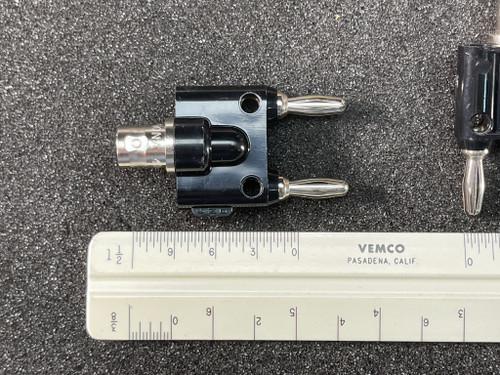
Unused new old stock (NOS). Clean physical condition with intact spring contacts and set-screw assembly. Body marked 1825. Sold each.
Same or next business day shipping from our Idaho warehouse. Reliable parts since 1999. Honest pricing, no nonsense.
A no-hassle satisfaction guarantee on every order.
Product Overview
Pomona 1825-0 is a stackable 4 mm banana plug engineered for test lead fabrication and bench instrumentation setups. The rear and side-stacking female jacks allow multiple jumper connections at a single test point without daisy-chain clutter. Wire attaches directly through the side entry port using an internal set screw, eliminating the need for soldering during custom cable assembly.
Key Features
- Standard 4 mm banana plug with rear and side female stacking receptacles
- Solderless wire termination using an internal 8-32 set screw
- Accommodates 22 AWG to 18 AWG wire sizes
- Nickel-plated beryllium copper spring contact for low-resistance connections
- Rated for 15 A continuous current
- Maximum voltage rating of 5000 Vrms hands-free
- Black polypropylene insulated body
Applications
- Building custom test bench leads and patch cords for electronics troubleshooting
- Stacking multiple multimeter or oscilloscope probe connections onto a single power supply binding post
- Breadboard and prototyping power rail hookups for maker bench projects
Frequently Asked Questions
What wire gauge does this plug accommodate?
The side entry port fits wire sizes from 22 AWG to 18 AWG, clamped securely by the internal set screw.
Can multiple plugs be stacked into this connector?
Yes. The body features both a rear jack and a side-entry port that accept standard 4 mm banana plugs for multi-connection patching.
What tool is needed to tighten the wire connection?
A standard flat-blade screwdriver secures the internal 8-32 set screw against bare wire strands; no soldering iron or crimp tool is required.
Nothing beats building a test lead exactly to length right at the bench. Strip a few millimeters of wire, snug down the set screw, and get back to troubleshooting.