

Product Overview
SHV Bulkhead Jack, 5kV DC, PTFE Insulator, Gold Solder Cup - Panel Mount High-Voltage Coaxial Connector
Condition
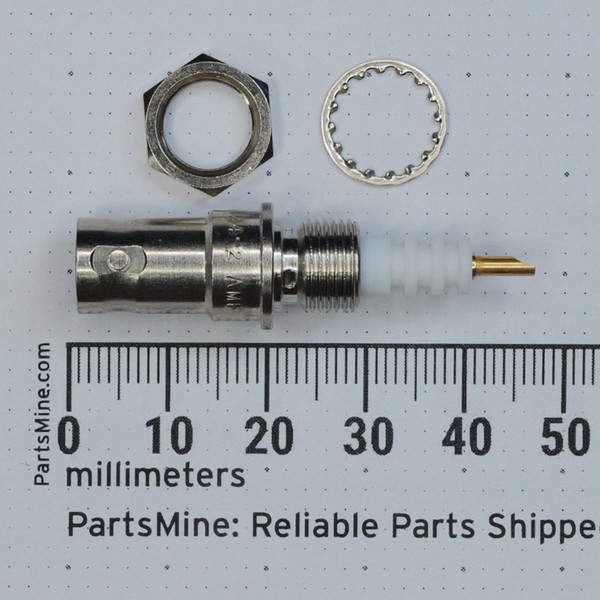
Unused NOS. Evaluation: Visual inspection only. Function testing not performed. Nickel-plated body with stamped code 51494 on the flange ring, white PTFE dielectric insulator intact, and gold-plated center pin present with no visible damage. Hex jam nut and internal-tooth lockwasher are included. Bulk-packed, without manufacturer's packaging. Sourced from a government research facility.
Same or next business day shipping from our Idaho warehouse. Honest pricing, no nonsense.
Online since 1999. We are here for our customers, with a no-hassle satisfaction guarantee.
Product Overview
AMP / TE Connectivity 51494-2 is an SHV (Safe High Voltage) bulkhead jack designed for panel-mounting on detector enclosures, NIM bin chassis, and high-voltage instrument panels. The solder-cup rear termination accepts a high-voltage wire directly. The bayonet front interface mates with an SHV male plug only - not BNC, not MHV. The deeply recessed center contact and ribbed PTFE insulator maximize creepage distance, keeping the live contact shielded even when the mating plug is withdrawn. Rated to 5,000 V DC. Nickel-plated body, gold-plated center contact.
Key Features
- Connector type: SHV (Safe High Voltage) coaxial bulkhead jack
- Voltage rating: 5,000 V DC
- Termination: Solder cup rear contact
- Mating interface: Bayonet coupling, accepts SHV male plug only
- Dielectric: PTFE (Teflon), ribbed for extended creepage distance
- Body plating: Nickel
- Contact plating: Gold
- Mounting: Bulkhead / panel mount, rear-threaded
- Maximum panel thickness: 0.187 in (4.75 mm)
- Hardware included: Hex jam nut and internal-tooth lockwasher
- Manufacturer: AMP / TE Connectivity, part number 51494-2
Applications
- Lab technician mounts the jack through the chassis of a PMT base, torques the hex nut down, and solders the dynode chain's high-voltage lead into the rear solder cup before energizing a scintillation detector
- Instrument builder drops the 51494-2 into a custom panel layout to bring a high-voltage supply output to an accessible front-panel interface, then routes the external SHV cable from the detector head
- Repair technician replaces a cracked or arc-tracked connector on a NIM bin module, restoring compliance with high-voltage safety standards that mandate this specific part number or a direct equivalent
- Geiger counter or fusor builder needing a proper 5 kV-rated panel connector instead of a repurposed BNC - the SHV interface prevents dangerous cross-connections by physical incompatibility
- Gamma spectroscopy hobbyist wiring a scintillator PMT base who wants the same safety standard used in professional nuclear instrumentation
Frequently Asked Questions
Will this mate with a standard BNC plug?
No. SHV and BNC connectors use a similar bayonet mechanism but are physically incompatible by design. This incompatibility is intentional - it prevents a low-voltage BNC cable from being connected to a high-voltage circuit accidentally.
Will an MHV plug mate with this jack?
No. MHV (Miniature High Voltage) and SHV are distinct standards with different physical geometries. An MHV plug will not mate with this SHV jack. Attempting to force one can damage the insulator.
Is mounting hardware included?
Yes. A hex jam nut and internal-tooth lockwasher are included with this unit, confirmed by inspection.
What panel thickness does this accommodate?
Maximum panel thickness is 0.187 in (4.75 mm). A standard "D" hole cutout prevents rotation during installation.
Is this the AMP / TE Connectivity part or an Amphenol part?
This is the AMP / TE Connectivity part. The body is stamped "AMP" and "51494-2." Amphenol produces equivalent SHV bulkhead jacks under different part numbers (such as 000-29100), but the 51494-2 designation belongs to AMP / TE Connectivity.
High-voltage work rewards the right connector - one whose insulator geometry was engineered to keep the contact recessed and the creepage distance honest. The 51494-2 has been doing exactly that job in physics labs and NIM bins for decades. Put it to work in yours.