

Product Overview
Amphenol 31-242 BNC Straight Crimp Plug — 50 Ohm, DC to 4 GHz, Cable Group B1 (RG-179, RG-187)
Condition
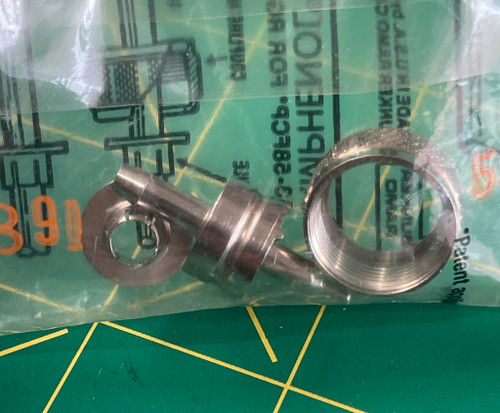
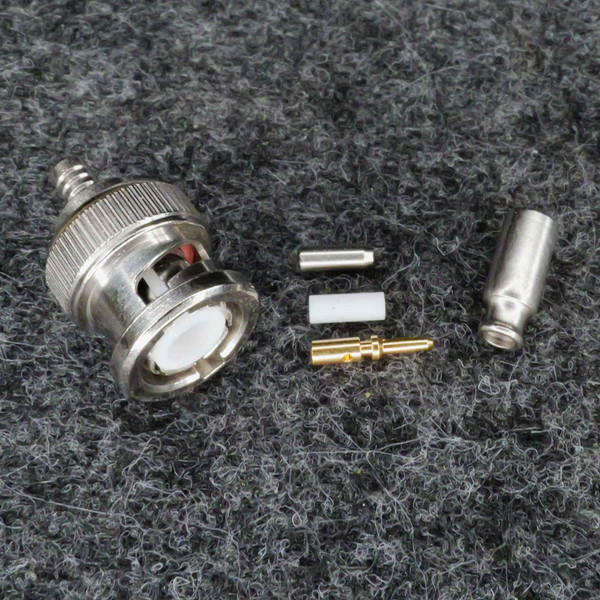
Unused NOS. Sourced from a government research facility and in original manufacturer's packaging. All components present: knurled nickel-plated body, PTFE dielectric, gold-plated center pin, ferrule, and crimp sleeve. No wear or corrosion observed.
Ships same or next business day from our Idaho warehouse. Honest pricing, no nonsense.
Online since 1999. We are here for our customers, with a no-hassle satisfaction guarantee.
Product Overview
Amphenol 31-242 is a BNC straight crimp plug engineered specifically for Cable Group B1 miniature coaxial cables — RG-179, RG-179A, RG-179B, RG-187, RG-187A, and Belden 9221. The nickel-plated brass body and gold-plated center contact hold 50 Ohm impedance across DC to 4 GHz. The PTFE (Teflon) insulator distinguishes the standard 31-242 from the commercial-grade 31-242-RFX variant, which uses a Delrin insulator. Termination is crimp on the outer ferrule; the center contact accepts crimp or solder.
Key Features
- Connector type: BNC straight plug, male pin
- Impedance: 50 Ohms
- Frequency range: DC to 4 GHz
- Termination: crimp ferrule (outer) / crimp or solder (center contact)
- Body: brass, nickel-plated
- Center contact: brass, gold-plated
- Insulator: PTFE (Teflon) — high-temperature performance grade
- Compatible cable group: B1 — RG-179, RG-179A, RG-179B, RG-187, RG-187A, Belden 9221
- Incompatible with RG-58, RG-59, RG-6, RG-174 — those cable diameters are too large for this connector's entry tail and ferrule
Applications
- Avionics repair: an AMT strips back a degraded RG-179 run from an aircraft radio or transponder, crimps the 31-242 onto the prepared cable end, and restores a reliable 50 Ohm signal path in a high-vibration environment where a generic connector would fail mechanically or electrically
- Test bench work: a field engineer builds or repairs a custom patch cable between a spectrum analyzer, signal generator, or oscilloscope and a miniature coax line — the bayonet lock seats fast and stays put during measurements up to 4 GHz
- QRP and portable amateur radio: builders running lightweight RG-179 or RG-187 feedlines in handheld or backpack rigs terminate with the 31-242 to keep impedance matched and connector mass minimal
- Homebuilt aircraft wiring: experimental aircraft builders sourcing avionics-grade hardware for instrument panel RF runs rely on Amphenol part numbers that meet the physical and electrical specs of their wiring diagrams
- Maker and lab use: anyone building compact RF test cables or breadboard patch leads for 50 Ohm setups who needs a genuine BNC plug that actually fits thin miniature coax
Frequently Asked Questions
Is this the PTFE version or the Delrin version?
This is the standard 31-242 with a PTFE (Teflon) insulator. The Delrin variant carries the suffix -RFX (31-242-RFX). PTFE offers higher thermal performance and is the specification required in aviation and military-adjacent applications.
Will this fit RG-58 or RG-174 cable?
No. The 31-242 is sized for Cable Group B1 miniature coaxial cables: RG-179, RG-179A, RG-179B, RG-187, RG-187A, and Belden 9221. RG-58, RG-59, RG-6, and RG-174 have outer diameters too large for this connector's entry tail and ferrule. Using the wrong cable size results in a connector that cannot be properly crimped and will fail in service.
What tools are needed to install this connector?
Installation requires a coaxial cable stripper sized for miniature coax and a crimp tool with the correct miniature hex die for BNC connectors in Cable Group B1. Standard BNC crimp tools sized for RG-58 will not produce a correct crimp on this connector.
What does this mate with?
This is a male BNC plug. It mates with any standard female BNC jack using the bayonet locking interface common on oscilloscopes, spectrum analyzers, signal generators, aircraft radios, and RF test equipment. It is not compatible with SMA, TNC, or N-type ports without an adapter.
Government surplus, Teflon-insulated, and built to the spec that avionics harness work actually demands — these are the connectors that belong on the job, not the ones that almost fit.