

Product Overview
The Brick That Put 48 Volts on the Spare Pairs of a Cat 5 Run
Condition
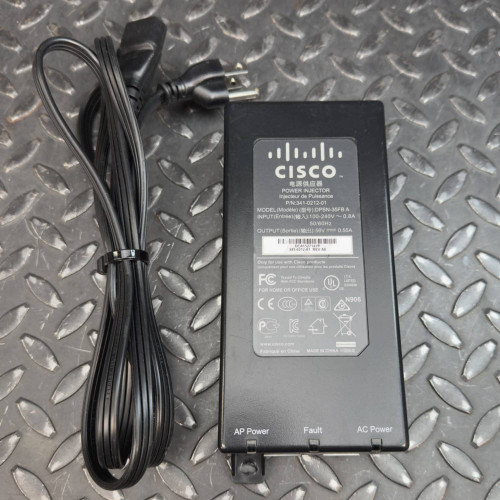
New old stock (NOS), unused. The photographed unit is representative of the two we have on the shelf. Its underside label is clean and fully legible, reading AIR-PWRINJ3, Cisco assembly 47-15936-01 Rev C0, serial FOC0816M8NS, Made in China. The front panel lettering for the two 10/100BaseTX ports and the Device Status and Power Status LEDs is crisp and unrubbed. The kit was photographed laid out in a plain corrugated box and includes the Cisco PSA18U-480C AC adapter with its captive DC lead and ferrite, a detachable two-prong mains cord with its factory warning tags still attached, a yellow Cisco Ethernet patch cable still in its bag labeled CAB-ETH-S-RJ45 / 72-1482-01, a closed zip-top hardware bag holding a tie wrap, tie mount, wall anchor and screw, and printed literature including a registration sheet. Nothing here has been put into service. It has also not been bench tested by us, so the photos and the labels are the spec.
Same or next business day shipping from our Idaho warehouse. Honest pricing, no nonsense.
Online since 1999. We are here for our customers, with a no-hassle satisfaction guarantee.
Product Overview
The Cisco AIR-PWRINJ3 is the mid-span power injector Cisco shipped with its early Aironet wireless gear, and it does one job cleanly: it takes 48 V DC from its own wall adapter and puts that power onto a Category 5 run alongside the data, so an access point mounted in a ceiling or on a pole needs only one cable instead of two. Per the unit's own label the injector's output is 48 V DC at 0.32 A, which is the 15 W Cisco publishes for it; the separate PSA18U-480C adapter is rated 100 to 240 V AC, 0.5 A, 50-60 Hz in and 48 V DC 0.38 A out, center positive, and is UL and cUL listed as an I.T.E. power supply under file E127643. That 0.38 A figure belongs to the adapter, not to the injector, and older copy for this part often confuses the two. Cisco's quick start guide for the Aironet Power Injector lists support for Aironet 350 series access points and bridges and the 1100 and 1200 series access points, gives the body as 5.4 x 2.1 x 1.3 in. (13.7 x 5.3 x 3.3 cm), and describes the power insertion method as the two unused pairs of the Cat 5 cable, pins 4 and 5 negative and pins 7 and 8 positive. The adapter label carries an April 2004 date block, which places this kit squarely in the era it was designed for. This is a Cisco-specific, pre-standard injection scheme; Cisco does not describe AIR-PWRINJ3 as an 802.3af injector, and neither do we.
Key Features
- Injector output 48 V DC at 0.32 A, marked on the unit's own label; Cisco rates it at 15 W
- Two RJ-45 ports marked 10/100BaseTX To Device and 10/100BaseTX To Network, plus a barrel DC input
- Device Status and Power Status LEDs on the front panel
- Powers the access point over the spare pairs 4/5 and 7/8 of a Category 5 cable, per Cisco's quick start guide
- Supports Cisco Aironet 350 series access points and bridges and 1100 and 1200 series access points, per that same guide
- Cisco assembly number 47-15936-01 Rev C0; FCC, CE, VCCI and C-tick marks on the label
- 5.4 x 2.1 x 1.3 in. (13.7 x 5.3 x 3.3 cm) per Cisco's published figures
- Includes the Cisco PSA18U-480C adapter (Cisco P/N 34-1977-03), mains cord, bagged yellow CAB-ETH-S-RJ45 patch cable, mounting hardware bag and printed literature, as photographed
- Weight and any compatibility beyond Cisco's listed 350/1100/1200 families are not confirmed - verify against the datasheet before use
Applications
- A network tech keeping a legacy Aironet 1200 alive in a warehouse ceiling where there is no outlet within thirty feet of the mount
- A school district IT shop that needs a drop-in replacement injector for an existing 1100 series install rather than a forklift upgrade to current APs
- A lab or test bench running a 350 series bridge for protocol work, where an original Cisco injector removes one variable
- A collector or trainer rebuilding a period-correct Cisco wireless setup and wanting the original brick, cable and hardware bag rather than a modern generic substitute
Frequently Asked Questions
Is the injector really 48 V at 0.38 A?
No, and this is the most common error in listings for this part. The injector's label reads output 48 V DC 0.32 A, input 48 V DC 0.38 A. The 0.38 A output belongs to the PSA18U-480C wall adapter that feeds it. Both labels are photographed here so you can read them yourself.
Will this power a non-Cisco PoE device?
Not confirmed, and we would not plan on it. AIR-PWRINJ3 puts power on the spare pairs in Cisco's own pre-standard scheme, and Cisco does not call it an 802.3af injector. Cisco's guide lists the Aironet 350 series access points and bridges and the 1100 and 1200 series access points. Anything beyond that list is unverified here - verify against the datasheet before use.
What exactly is in the box?
What you see in the photos: the injector, the Cisco PSA18U-480C adapter with captive DC lead, a detachable mains cord, a bag holding the yellow Cisco patch cable marked CAB-ETH-S-RJ45, a closed zip-top hardware bag with a tie wrap, tie mount, wall anchor and screw, and printed literature. We have not opened the cable bag or the hardware bag to count or inspect their contents.
Why buy this one instead of taking a chance on a surplus lot?
Because this is a specific photographed kit, not a raffle. You can read the injector's serial and assembly number, the adapter's model and agency file number, and the cable bag's Cisco part number in the photos before you commit, and we only have two. A pallet of pulled networking gear might hold a working injector, or it might hold three power bricks and no injector at all. This one clears our free shipping line on its own, and orders leave the Idaho warehouse the same or next business day.
Somewhere there is still a ceiling tile with an Aironet above it and no outlet anywhere near, which is the entire problem this small black brick was designed to make disappear. Twenty years on, it is still the answer to that problem, and it is still waiting in the box for someone to run the cable.