

Product Overview
ST L6203 Full Bridge Driver: Four DMOS Switches on One Multiwatt11 Tab
Condition
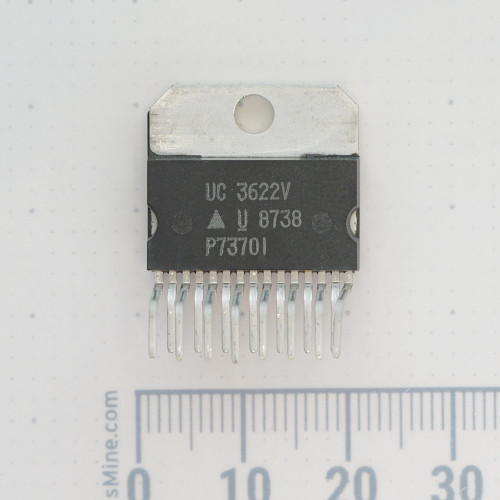
Condition is New, and with more than one in stock the photographed chip is representative of the stock rather than the exact piece you receive. In the photos the Multiwatt11 body is dark epoxy with a bright metal mounting tab and a single through hole, and the face is cleanly marked with the ST logo, L6203, the trace code R883X0229, and SINGAPORE. The eleven leads sit in the staggered two-row pattern the Multiwatt11 package forms them into, bright and free of solder or flux in these photos. Trace codes vary from piece to piece across a shelf, so the code on the chip you receive may read differently. Sold Each: one driver per unit.
Same or next business day shipping from our Idaho warehouse. Honest pricing, no nonsense.
Online since 1999. We are here for our customers, with a no-hassle satisfaction guarantee.
Product Overview
The L6203 is ST's DMOS full bridge driver, built on the Multipower-BCD process that places isolated DMOS power transistors, CMOS logic, and bipolar circuitry on a single die so the control side and the power stage can each be optimized instead of compromised against each other. In practice that means four power switches arranged as an H bridge, TTL compatible logic inputs plus an enable, cross conduction protection so the high side and low side of a leg do not both turn on, and sense connections for current limiting or chopper control. It comes in the 11-lead Multiwatt11 package with the tab and mounting hole visible in the photos, which is the mechanical and thermal interface to whatever heatsink your design uses. ST's published figures for the L6203 are a supply rail up to 48 V, 5 A peak output current, roughly 4 A total RMS, about 0.3 ohm typical on-resistance per DMOS switch, and operation to around 100 kHz; those come from the datasheet and not from any measurement here, so verify against the ST datasheet before designing around them. Bootstrap capacitors, sense resistors, and heatsink hardware are part of a working circuit and are not included.
Key Features
- Marked on the photographed chip: ST logo, L6203, trace code R883X0229, and SINGAPORE
- Multiwatt11 package, eleven staggered leads, bright metal tab with a mounting through hole
- DMOS full bridge output stage on ST's Multipower-BCD process, logic and power on one die
- TTL compatible logic inputs with enable, plus cross conduction protection within each bridge leg
- Sense connections available for current sensing, current limiting, or chopper drive schemes
- Electrical ratings not confirmed here: verify against the ST datasheet before use
- Condition New, Sold Each, photographed unit representative of the stock
Applications
- A robotics builder running a brushed DC gearmotor in both directions from a microcontroller, without wiring up four discrete MOSFETs and a separate gate driver
- A repair tech replacing a failed L6203 on a machine tool axis board or an older motion controller, matching the original Multiwatt11 footprint exactly
- A bench experimenter driving a small bipolar stepper with two of these, one bridge per winding, on a heatsink sized to keep the tab cool
- An automation retrofitter keeping a legacy through-hole driver board alive instead of redesigning the whole card around a modern surface mount part
Frequently Asked Questions
What do the markings on the photographed chip say?
The face carries the ST logo, the type number L6203, the trace code R883X0229, and SINGAPORE. The type number is what you are buying; the trace code belongs to the piece that sat in front of the camera and will vary from unit to unit across the stock.
What voltage and current will it handle?
Not confirmed here. ST's datasheet for the L6203 lists a supply rail up to 48 V, 5 A peak output current, roughly 4 A total RMS, and about 0.3 ohm typical on-resistance per switch. Nothing was measured on this chip, so verify against the ST datasheet before use.
Does it need a heatsink?
The tab and its through hole exist because at any real current it does. The tab is the thermal path out of the die, and how much heatsink you need depends on your current, duty cycle, and ambient temperature. Verify against the datasheet's thermal figures before use.
Can it drive a bipolar stepper?
A bipolar stepper wants one full bridge per winding, so two L6203s make up a driver, with the sense connections available if you are chopping current. The supporting design work, including bootstrap capacitors and sense resistors, is yours and the datasheet's.
Why buy three of these here instead of a tray of twenty-five?
Because a two-motor rover needs two, a bipolar stepper needs two, and a board repair needs one. We stock these in quantity and sell them Each, so you count out exactly what the design calls for instead of paying for a full tube and shelving the remainder for a decade. Shipping is $8 flat rate, free once your order passes $28, and orders leave our Idaho warehouse the same or next business day.
Four DMOS switches, one metal tab, and a slice of on-chip logic whose main job is making sure two of those switches never close at the same time. If you have a motor that needs to run both directions on command, the rest of the design is yours.