
Product Overview
Fixed Metal Film Passive Component for Prototyping and Board Repair
Condition
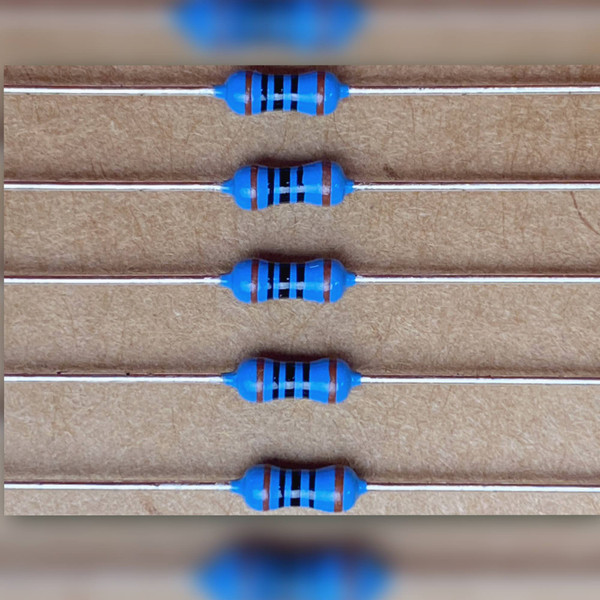
This item is unused new old stock (NOS). Axial wire leads are straight and clean with intact blue conformal coating and clear five-band color markings.
Ships same or next business day from our Idaho warehouse. Honest pricing, no nonsense.
Online since 1999. We are here for our customers, with a no-hassle satisfaction guarantee.
Product Overview
This 100 ohm metal film resistor provides 1/4 watt power dissipation and a tight 1% tolerance for analog circuits, prototyping, and component-level repairs. Axial leads make it ready for standard solderless breadboards, perfboards, and through-hole printed circuit assemblies.
Key Features
- Resistance value: 100 ohms (100 Ω)
- Tolerance: ±1%
- Power rating: 1/4 Watt (0.25 W)
- Construction: Metal film with blue conformal coating
- Mounting type: Through-hole axial lead
- Color code: Five-band (Brown, Black, Black, Black, Brown)
Applications
- Breadboard prototyping and circuit testing for pull-up or pull-down networks
- Repairing legacy audio equipment, instrument controls, and power supply boards
- Maker projects requiring stable 100-ohm current limiting
Frequently Asked Questions
How do the five color bands decode on this resistor?
The five bands read brown (1), black (0), black (0), black (multiplier of 1), and brown (±1% tolerance), confirming 100 ohms at 1% precision.
Will these leads fit standard 0.1-inch breadboards?
Yes. The axial wire leads fit standard 0.1-inch pitch breadboards, perfboards, and through-hole PCB footprints.
Can I buy just the quantity needed for my repair or build?
Yes. You can order the exact count required for your project without committing to full reels or excess multi-value kits. More pieces cost less each, and the price-break table on this page shows what each quantity costs. Shipping is an $8 flat rate, orders over $28 ship free, and everything ships same or next business day from our Idaho warehouse.
A dependable 100-ohm metal film resistor is the quiet anchor of the workbench, stepping in wherever circuit bias or pull-up stability matters. Bend the leads, seat it into the board, and let the build move forward.