

Product Overview
33nF 100V Green Dipped Polyester Film Capacitor - Non-Polarized Through-Hole Leads
Condition
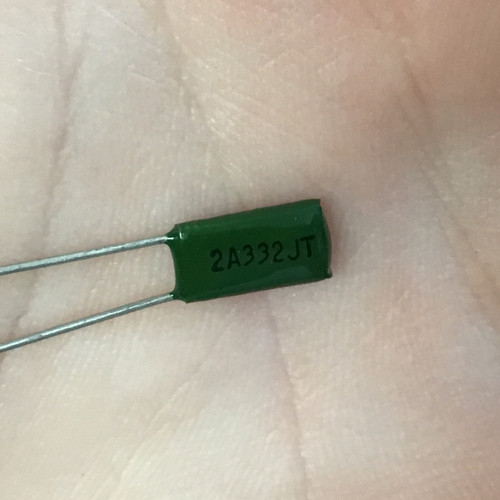
Unused, new old stock (NOS). Markings legible: 333J 100N. Green epoxy coating intact; leads straight and unbent. No maker's logo on the body. Sold each.
Ships same or next business day from our Idaho warehouse. Honest pricing, no nonsense.
Online since 1999. Satisfaction guaranteed, every time.
Product Overview
Unbranded 33nF (0.033uF) film capacitor rated 100V DC with ±5% tolerance, marked 333J 100N. A green epoxy-dipped polyester film body sits on two radial wire leads, non-polarized, for through-hole boards in audio, timing and filter circuits.
Key Features
- Capacitance: 33nF (0.033uF / 33,000pF), code 333
- Tolerance: ±5% (code J)
- Voltage rating: 100V DC (code 100N)
- Dielectric: polyester (Mylar) film, green epoxy dip coat
- Non-polarized
- Two long straight radial wire leads for through-hole mounting
Applications
- Drops into the tone stack or treble-bleed position of a guitar pedal or amp build that calls for 0.033uF.
- Sets the RC time constant in a 555 timer or oscillator on a breadboard prototype.
- Couples or filters audio between op-amp stages in a preamp or synth module.
- Replaces a 333-coded cap on an older board during component-level repair.
Frequently Asked Questions
Does it matter which way it goes in?
No. It is non-polarized, so either lead can go to either pad.
How do I read the 333J 100N marking?
333 is 33 followed by three zeros in picofarads: 33,000pF, which is 33nF or 0.033uF. J is ±5% tolerance. 100N marks the 100V DC rating.
Can it replace a 0.033uF cap in a pedal or amp circuit?
Yes, where the original value is 0.033uF / 33nF and the circuit runs at or below 100V DC. Film is the usual choice in audio tone and coupling positions.
The price per piece steps down with quantity, and the price-break table on this page shows each step.
Green dipped caps like this one sit in tone circuits everywhere doing one quiet job: holding 33nF exactly where the schematic asks for it. Solder it in, close the case, and let the circuit sound the way it was drawn.