

Product Overview
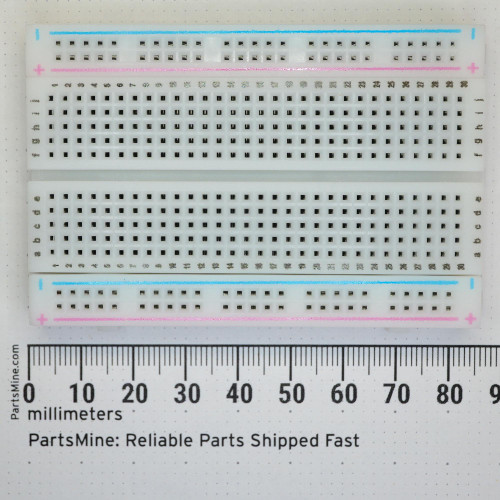
Transparent 830 Tie-Point Plug-In Prototyping Board with Power Rails
Condition
New condition. Sold each. Clear transparent plastic housing with unpeeled self-adhesive foam backing tape on the reverse. Markings legible: ZY.
Same or next business day shipping from our Idaho warehouse. Reliable parts since 1999. Honest pricing, no nonsense.
We are here for our customers, with a no-hassle satisfaction guarantee.
Product Overview
Built for rapid circuit assembly and testing, this transparent 830-point solderless breadboard accommodates standard dual-in-line ICs, discrete components, and jumper wires without soldering. The clear housing allows direct visibility of the internal spring clips for alignment and educational inspection, while color-coded positive and negative rails simplify DC power distribution across the board.
Key Features
- 830 total tie points arranged as 630 tie points across 63 terminal rows and 200 tie points across 4 power distribution rails
- Standard 0.100 inch (2.54 mm) hole spacing accommodates DIP integrated circuits and header pins
- Compatible with solid wire from 20 AWG to 29 AWG (0.3 mm to 0.8 mm diameter)
- Clear transparent ABS plastic body exposes internal phosphor bronze contact clips
- Interlocking dovetail tabs and slots along edges allow modular expansion with identical boards
- Full-coverage peel-and-stick adhesive backing for secure mounting to project enclosures or baseplates
Applications
- Prototyping microcontroller circuits with Arduino, ESP32, or Raspberry Pi Pico development boards on a workbench.
- Building and testing analog filter or sensor interface layouts before committing to a custom printed circuit board.
- Classroom and laboratory demonstrations where students need to observe internal contact mechanics and bus line continuity.
- Assembling modular DIY synth modules or audio effects pedals during initial stage testing.
Frequently Asked Questions
What wire gauge works best with this breadboard?
The internal spring contacts accept 20 AWG to 29 AWG solid wire, standard 0.1 inch header pins, and DIP-packaged integrated circuits.
Are the power distribution rails continuous along the full length?
The top and bottom power rails are split into two 25-contact sections on each rail, marked with red and blue polarity lines.
Can multiple breadboards be interlocked?
Yes. Molded tabs and slots along the perimeter lock into matching boards to expand workspace horizontally or vertically. The price per piece steps down with quantity, and the price-break table on this page shows each step.
A clear shell takes the mystery out of the bus lines, letting you spot a missed pin or a bent lead before you ever apply power. Plug in your components, run your jumpers, and see exactly where the signal goes.