

Product Overview
Aerospace-Grade Teledyne Taber 2210 Pressure Transducer, 0-500 PSIA, With an Etched EG&G Spec Callout
Condition
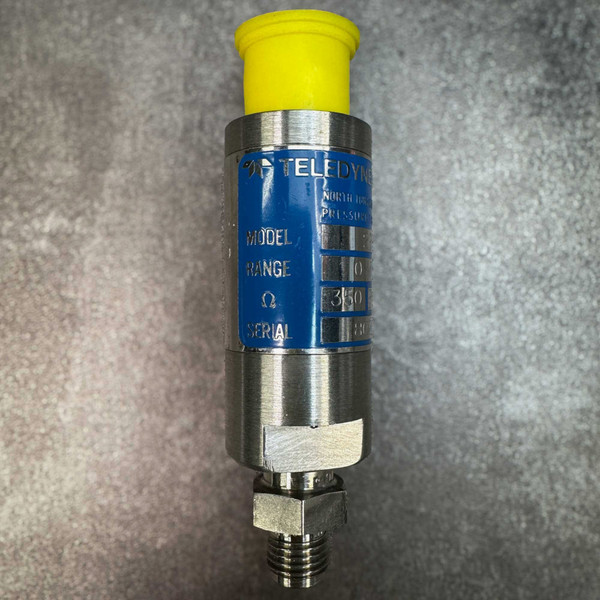
New, unused stock that has not been placed into service. More than one is on hand, so the photographed piece is representative and its serial number belongs to that piece only. On that unit the blue nameplate is legible line by line: Teledyne Taber, North Tonawanda NY USA, pressure transducer, model 2210, range 0-500, 350 next to the omega symbol, PSIA, serial 802820. The stainless body is bright, with fine machining and handling marks and a faint marking below the etched spec line that is not legible enough to attribute to anyone. A yellow Caplugs NAS-820-12-12S protective cap sits over the upper threaded end in the photos, so nothing underneath that cap is shown. At the other end the male threaded pressure port is open and clean, with hex wrench flats above it and a small drilled hole in the machined flat. No excitation has been applied, no pressure has been applied, and no calibration paperwork comes with it.
Same or next business day shipping from our Idaho warehouse. Honest pricing, no nonsense.
Online since 1999. We are here for our customers, with a no-hassle satisfaction guarantee.
Product Overview
The Teledyne Taber 2210 is aerospace-grade instrumentation: a machined stainless pressure transducer from a line built for aerospace and high-reliability test work, and this one carries the configuration its nameplate states: range 0-500, marked PSIA, which means the reading is referenced to a sealed vacuum rather than to whatever the barometer is doing that day. The omega line reads 350, the bridge resistance in ohms, so this is an analog instrument with a resistive bridge output that needs an external excitation supply and signal conditioning; excitation voltage, full scale output and accuracy class are not confirmed here, so verify against the datasheet before use. The body is etched with a spec callout reading EG&G, REV A, dated 10-30 with the year no longer legible, which says the unit was built against a customer specification rather than a catalog default - the exacting-customer pattern that aerospace-grade work tends to leave behind, and one more reason to confirm pinout and output before wiring it into a live channel. Mechanically it is straightforward: a cylindrical stainless body, hex wrench flats for installation torque, a male threaded pressure port with an open bore, and a threaded upper end that appears in these photos under a yellow aerospace-style protective cap. Teledyne Taber built these in North Tonawanda, New York, per the nameplate.
Key Features
- Nameplate range 0-500, marked PSIA for absolute reference
- 350 marked under the omega symbol, the bridge resistance in ohms
- Model 2210, serial 802820 on the photographed unit
- Teledyne Taber, North Tonawanda NY USA, per the nameplate
- Machined stainless body with hex wrench flats
- Male threaded pressure port with an open bore
- Etched spec callout reading EG&G, REV A, dated 10-30 with the year not legible
- Yellow Caplugs NAS-820-12-12S protective cap fitted over the upper end in the photos
- Analog bridge output, external excitation and conditioning required; excitation and full scale output not confirmed - verify against the datasheet before use
Applications
- Instrumenting an aerospace or industrial hydraulic and pneumatic test stand where the channel has to read absolute pressure up to 500 PSIA instead of gauge pressure
- Adding a shelf spare to a rack that already runs aerospace-grade Taber transducers, so the port, the wrench flats and the 350 ohm bridge match what the conditioner already expects
- Keeping older aerospace ground support instrumentation running, where the original channel was called out on a customer spec sheet and a modern substitute would mean requalifying it
- Calibration lab bench work, where an aerospace-grade absolute reference channel gets characterized against a deadweight tester before it is trusted with data
Frequently Asked Questions
What does the PSIA marking mean for my readings?
PSIA is absolute pressure, referenced to a sealed vacuum inside the transducer instead of to ambient air. With the port open at sea level it sees roughly 14.7 PSI, not zero. If your rig expects gauge pressure you will need to subtract ambient in software or use a PSIG unit instead.
What is the 350 on the label?
That is the bridge resistance in ohms. The 2210 is an analog transducer with a resistive bridge output, so it needs an external excitation supply and an instrumentation amplifier or signal conditioner. Excitation voltage, full scale output and accuracy class are not confirmed here - verify against the datasheet before use.
What is under the yellow cap?
In these photos the upper threaded end wears a yellow Caplugs NAS-820-12-12S protective cap, and it was not pulled for the camera, so the connector arrangement underneath is not shown. Confirm the pinout against the datasheet before you wire it in.
This is aerospace-grade - does it come tested or certified?
It is aerospace-grade instrumentation, and the body carries an etched EG&G spec callout showing it was built to a customer specification rather than a catalog default. What it does not come with is paperwork: no calibration certificate, no test data, no traceability file. No excitation has been applied and no pressure has been applied here. The nameplate and the photographs are what we can confirm.
What am I actually taking on with this one?
You are buying an unused instrument, not a verified one. What is certain is what the camera shows: model 2210, range 0-500 PSIA, 350 on the omega line, a clean open pressure port, a bright stainless body and an etched EG&G spec callout. What is not certain is how it performs, because nothing here has been powered or pressurized, and that etched spec means the build may not match a catalog datasheet. Buy it as a piece you will characterize on your own bench, and price your time accordingly. This one clears our free shipping line on its own, and it leaves our Idaho warehouse the same or next business day.
Teledyne Taber machined this one in North Tonawanda to somebody else's spec sheet, stamped it 0-500 PSIA, and then it waited with its dust cap on. Your test stand can be the first thing that ever asks it a question.