

Product Overview
Federal 087-004 Selenium Rectifier Bridge - 6-Plate Stack, Stud Mount, Olive Drab, Unused NOS
Condition
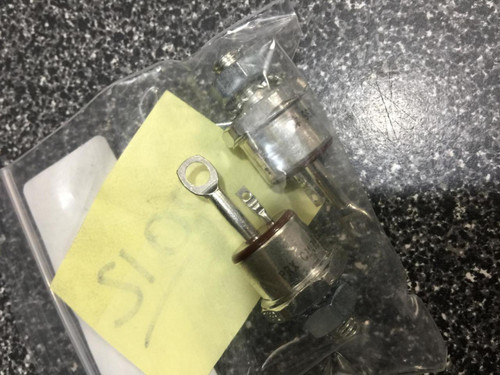
Unused NOS. Evaluation: Visual inspection only. Function testing not performed. Markings legible: FEDERAL, 087-004, 106M3507S. Olive-drab painted 6-plate body with dual threaded studs, brass hardware, and formed mounting feet intact. Light surface dust only; no damage observed. Sourced from a government research facility.
Same or next business day shipping from our Idaho warehouse. Reliable parts since 1999. Honest pricing, no nonsense.
We are here for our customers, with a no-hassle satisfaction guarantee.
Product Overview
Federal brand selenium rectifier bridge, part number 087-004, also marked 106M3507S. A 6-plate stud-mount stack that converts AC to DC using selenium-coated metallic plates - the rectifier technology that powered vintage industrial equipment, military electronics, and tube-era audio and radio gear before silicon diodes took over. Chassis-mount design with central threaded studs, hex nuts, washers, and terminal tabs for direct lug or bolt connections. Olive-drab finish with stamped identification codes on the plate face.
Key Features
- Plate count: 6 plates
- Plate dimensions: approximately 3" x 3" (approx. 76 mm x 76 mm) per plate
- Overall stack footprint: approximately 4" x 4" x 4" (approx. 101 mm x 101 mm x 101 mm)
- Mounting style: central threaded stud with hex nuts, washers, and integral terminal tabs
- Finish: olive-drab protective paint coating
- Stamped markings: FEDERAL, 087-004, 106M3507S visible on plate face
- Terminal tab detail: red and yellow paint band markings on lower tabs for polarity identification
- Incompatible with PCB through-hole and SMD layouts; not suited for high-frequency switching circuits
- Maximum voltage and current ratings: not confirmed
Applications
- Period-correct restoration of vintage military surplus electronics where the original selenium stack must be retained for authenticity
- Antique radio and tube amplifier restoration requiring a chassis-mount rectifier with the correct physical footprint and terminal style
- Industrial equipment repair on legacy machines originally built around stud-mount selenium bridge assemblies
- Museum or display use for working demonstrations of pre-silicon AC-to-DC conversion technology
- Collectors and vintage electronics hobbyists building a reference collection of NOS selenium components
Frequently Asked Questions
What are the voltage and current ratings for the 087-004?
Exact voltage and current ratings are not confirmed - they do not appear on the casing and no datasheet has been located for this specific part number. Buyers should determine ratings through circuit analysis or bench testing before deployment in a live circuit.
Is this compatible with a printed circuit board?
No. This is a chassis-mount stud assembly. It requires a central mounting stud through a chassis panel and direct terminal lug or bolt connections for AC input and DC output. It is not compatible with standard PCB through-hole or surface-mount layouts.
Do selenium rectifiers degrade in storage even when unused?
Yes. Selenium rectifiers are known to increase internal resistance over time regardless of storage conditions. This unit shows no physical damage, but electrical performance should be verified before use in a critical application. Additionally, overheated or failing selenium rectifiers can release hydrogen selenide fumes - handle and test with adequate ventilation.
Can a silicon diode be substituted instead?
Silicon diodes are the common modern replacement for selenium stacks in most restoration work. A series voltage-dropping resistor is typically added to compensate for the lower forward voltage drop of silicon. This original selenium unit is the correct choice when visual or functional authenticity to the period design is required.
Selenium stacks like this one went out of production decades ago, yet the machines they powered are still out there - waiting on exactly this shape of fix. One NOS bridge from a government shelf, ready to put an old circuit back to work.