

Product Overview
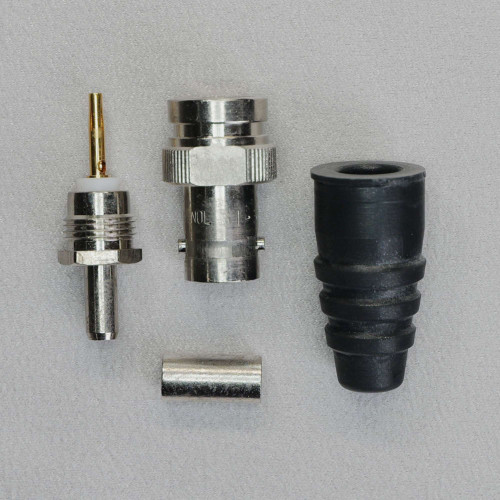
Panel Mount Coaxial Jack with Solder Cup Terminal and Hardware
Condition
Unused new old stock (NOS). Body stamped 74868. Includes hex mounting nut and internal-tooth lock washer. Sold each.
Same business day shipping from our Idaho warehouse. Reliable parts since 1999. Honest pricing, no nonsense.
We are here for our customers, with a no-hassle satisfaction guarantee.
Product Overview
Amphenol UG-1094/U (CAGE 74868) is a 50-ohm BNC female coaxial connector engineered for panel-mount bulkhead installations. Designed with a rear solder-cup terminal and 3/8-32 UNEF mounting threads, this RF receptacle provides secure chassis feedthrough for high-frequency instrument and radio interconnects up to 4 GHz.
Key Features
- 50-ohm characteristic impedance rated from DC to 4 GHz
- BNC female (jack) receptacle with standard bayonet coupling
- Bulkhead panel front mount with 3/8-32 UNEF-2A threaded shank
- Single-conductor rear solder-cup contact termination
- PTFE dielectric insulator with nickel-plated brass body
- Includes matching hex mounting nut and internal-tooth lock washer
Applications
- Mounting an external RF input or output port onto custom chassis, aluminum enclosures, or ham radio gear.
- Replacing worn or damaged BNC test-port receptacles on legacy oscilloscopes, signal generators, and spectrum analyzers.
- Wiring custom RF patch panels and benchtop instrumentation enclosures requiring reliable 50-ohm feedthroughs.
Frequently Asked Questions
What panel cutout size is required for installation?
The connector has a 3/8-32 UNEF threaded shank, which mounts through a standard 3/8-inch (0.375 inch) round panel cutout.
What dielectric insulation does this receptacle use?
This connector features a solid PTFE (Teflon) dielectric insulator.
What commercial part number does this connector cross-reference?
This connector meets military standard UG-1094/U and corresponds to Amphenol commercial part number 031-221, with 74868 stamped on the barrel representing Amphenol's federal CAGE code.
The BNC bayonet twist hasn't changed in decades because nothing beats a quick, positive mechanical lock on a chassis wall. Thread the nut, tack the center pin, and put another solid panel jack into service.