

Product Overview
940 nm Infrared Silicon PIN Photodiode with Visible-Light Blocking Black Resin, 2-Lead Radial Through-Hole
Condition
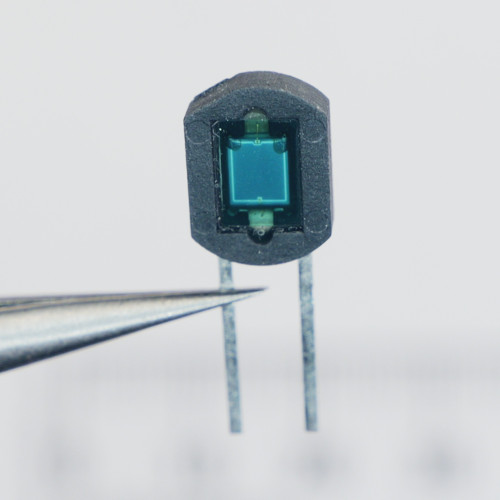
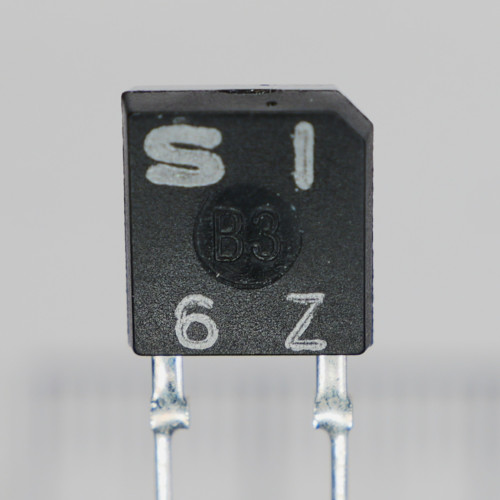
Condition: unused new old stock (NOS). Markings legible: 516 AD. Black glossy epoxy body with two straight, uncut leads, one slightly longer than the other. Sold each.
Ships same or next business day from our Idaho warehouse. Honest pricing, no nonsense.
Online since 1999. Satisfaction guaranteed, every time.
Product Overview
A silicon PIN photodiode from Lite-On, part number LTR-516AD, built to catch 940 nm infrared while its black resin body blocks visible light. It sits on the receiving end of IR remote, beam-break and reflective sensing circuits, in a 2-lead radial package with 2.54 mm lead spacing that drops straight into 0.1 in perfboard, breadboard or a standard PCB footprint.
Key Features
- Device type: silicon PIN photodiode
- Peak sensitivity wavelength: 940 nm
- Spectral bandwidth: 770 nm to 1000 nm
- Black visible-light blocking resin package
- Response time: 50 ns
- Maximum reverse voltage: 30 V
- Maximum power dissipation: 150 mW
- Dark current: 30 nA max at 10 V reverse
- Operating temperature: -40°C to +85°C
- Through-hole radial, 2 leads, 2.54 mm (0.10 in) lead spacing
Applications
- Swapping out the receiving diode in an IR beam-break sensor on a conveyor counter or door safety beam, paired with a 940 nm IR LED across the gap.
- Building a reflective tachometer: bounce a 940 nm LED off a fan blade or motor shaft mark and count the pulses this diode returns.
- Reading TV remote bursts on a scope or microcontroller pin through a transimpedance amp or load resistor to decode a remote protocol.
- Line-following and edge-detect sensors on hobby robots, where the visible-blocking body keeps room light from swamping the signal.
Frequently Asked Questions
What light does it respond to?
Near infrared from 770 nm to 1000 nm, peaking at 940 nm. The black resin blocks visible light, so it pairs naturally with common 940 nm IR LEDs and shrugs off ordinary room lighting.
Will it fit a standard 0.1 in board?
Yes. It is a 2-lead radial through-hole part with 2.54 mm (0.10 in) lead spacing.
What reverse voltage can I run it at?
Up to 30 V reverse. Dark current is 30 nA max at 10 V reverse, and response time is 50 ns, so a modest reverse bias gives fast, clean pulses for remote and beam-break signals.
How do I tell it apart from a look-alike IR LED or phototransistor?
The top face carries the molded marking 516 over AD. The body is black visible-blocking resin with two leads, rather than the clear or blue-tinted lens typical of IR emitters.
Infrared does its work where nobody can see it, and a 940 nm photodiode is the part that notices. Put one across a doorway or under a spinning blade and it starts counting for you.