

Product Overview
Hamamatsu R660 Side-On Photomultiplier Tube, 10 Dynode Stages, Unused New Old Stock
Condition
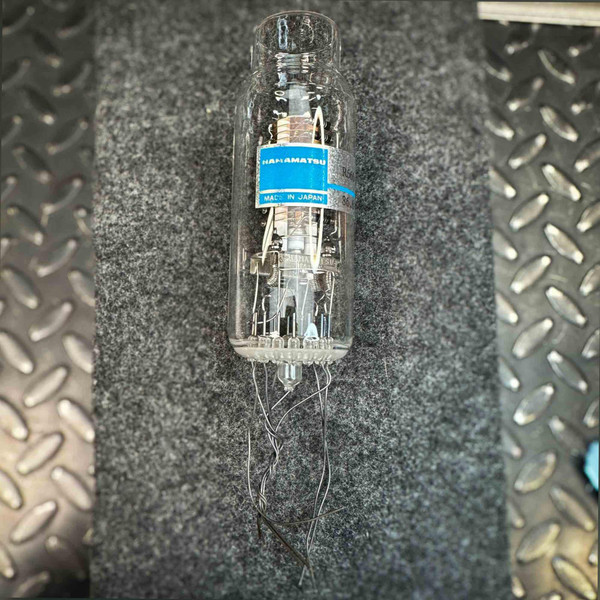
Unused, New Old Stock; clean and in excellent condition. In the photos the glass envelope is clear and bright, with no cloudiness, chips, or mirrored deposits anywhere on it. The blue Hamamatsu label wrapped around the neck reads R660 and 86.6, with MADE IN JAPAN printed under the logo, and the internal shield beside the dynode stack is embossed HAMAMATSU JAPAN. The copper and ceramic dynode hardware inside the envelope is bright and untarnished. A separate white label photographed with the tube reads TYPE R660, No. EA9680. At the base, the glass press and its ring of pin seals are undamaged and the central tip-off appears intact; the leads coming off the base are long flexible wires, several of them bent and crossed rather than lying straight. No socket, base assembly, voltage divider, or original carton is included. You get the single tube shown in the photos.
Same or next business day shipping from our Idaho warehouse. Honest pricing, no nonsense.
Online since 1999. We are here for our customers, with a no-hassle satisfaction guarantee.
Product Overview
The Hamamatsu R660 is a side-on photomultiplier tube built for low-light detection from the ultraviolet into the visible range. A bialkali photocathode behind a borosilicate glass window feeds a 10-stage circular-cage dynode chain, giving a gain of roughly 10^6 at 1000 V with a rise time near 2.2 ns and transit time spread around 0.28 ns. Spectral response runs 300-650 nm with a peak near 420 nm, photocathode area is approximately 22 mm, and the tube uses a 14-pin base in a 28 mm diameter envelope. This is the exact tube in the photographs, shown alongside a separate white label reading TYPE R660, No. EA9680, and stock is one.
Key Features
- Type: side-on photomultiplier tube (PMT), bialkali photocathode
- Spectral response: 300-650 nm, peak near 420 nm
- Dynode stages: 10, circular-cage structure
- Gain: approximately 10^6 at 1000 V
- Rise time: approximately 2.2 ns; transit time spread approximately 0.28 ns
- Anode dark current: a few nA after 30 minutes of operation
- Window: borosilicate glass; photocathode area approximately 22 mm
- Base: 14-pin; envelope diameter 28 mm
- Operating voltage: 1000 V typical, 1500 V maximum
- Temperature range: operating 0 C to +50 C; storage -30 C to +70 C
- Markings visible in photos: R660 and 86.6, MADE IN JAPAN on the tube label; a separate white label reads TYPE R660, No. EA9680
Applications
- Spectroscopy technician rebuilding the detector head on a fluorescence instrument that was designed around a side-on tube
- Instrument repair shop keeping an older UV-visible analyzer in service after its original detector goes dark
- Radiation counting builder pairing a scintillator with a 10-stage tube for low-level counting work
- Research group or teaching lab holding a spare photon-counting detector for a low-light optical bench
Frequently Asked Questions
Has this tube been powered or tested?
No. It is sold as unused New Old Stock, which means it has never been installed and never operated, and we have not put high voltage on it here. Treat the photographs as the physical record and verify the parameters your design depends on against the Hamamatsu R660 datasheet before you commit to it.
What markings are actually on the tube?
The blue label around the neck reads R660 and 86.6 with MADE IN JAPAN below the logo. The metal shield inside the envelope is embossed HAMAMATSU JAPAN. A separate white label photographed with the tube, lying on the bench rather than affixed to the glass, reads TYPE R660, No. EA9680; the photos do not show that number anywhere on the tube itself.
How do the base leads terminate, and is a socket included?
The tube is specified with a 14-pin base. In these photographs the leads at the base end are long flexible wires, several of them bent and crossed, rather than straight rigid socket pins, and the exact count cannot be read off the images with confidence. No socket, base assembly, or voltage divider ships with it. If the exact base termination matters for your build, ask us before ordering and we will look at the tube in hand.
What supply does it need to run?
Typical operating voltage is 1000 V with a 1500 V maximum, and gain of roughly 10^6 is quoted at 1000 V. That means a stable high-voltage supply and a dynode voltage divider, neither of which is included here. Anode dark current is specified as a few nA after about 30 minutes of operation, so plan on a warm-up before you trust a low-light reading.
Why buy this one photographed tube instead of chasing a surplus lot of PMTs?
A photomultiplier is not something anyone buys by the handful. This is a single tube, stock of one, shown from every side with its label, the accompanying TYPE R660 number label, its dynode stack, and its base leads all visible before you spend anything. A mixed detector lot or an auction pallet means paying for tubes you did not want and learning about the glass only when the box lands on your bench. Here you are buying the exact tube in the pictures, it clears our free shipping line on its own, and orders leave our Idaho warehouse the same or next business day.
Hamamatsu sealed this one in Japan, wrapped a blue label around its neck, and it has spent every year since in the dark, which happens to be exactly where a photomultiplier is happiest. Give it high voltage and a few stray photons, and it will go back to counting them one at a time.