


Product Overview
Matched Dual JFET in a TO-71 Metal Can, Built for Differential Precision
Condition
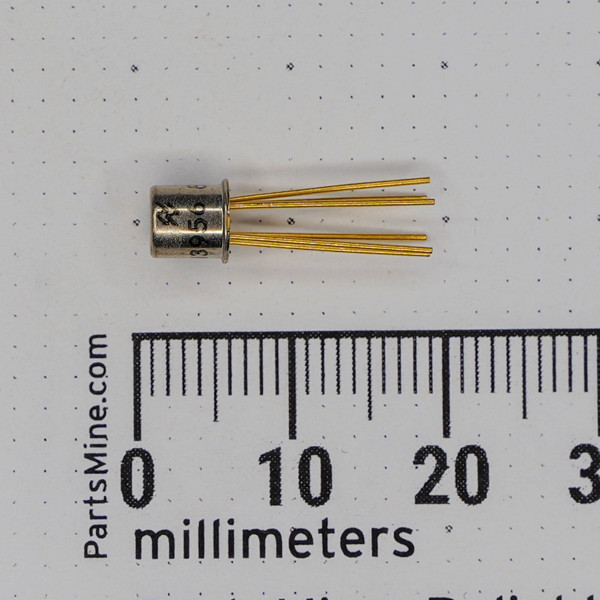
Unused, New Old Stock, supplied as loose parts. The nickel-finish TO-71 can is stamped with the National Semiconductor logo and the 2N3956 part marking wrapped around the body. All gold-plated leads are straight and bright, with no oxidation or bends visible. Against the PartsMine ruler the can body measures approximately 5 mm across, not counting the base flange.
Same or next business day shipping from our Idaho warehouse. Honest pricing, no nonsense.
Online since 1999. We are here for our customers, with a no-hassle satisfaction guarantee.
Product Overview
The National Semiconductor 2N3956 is a monolithic dual N-channel junction field-effect transistor: two closely matched JFETs on a single die, packaged in a TO-71-6 metal can with gold-plated leads. The can in our photos carries National's logo stamp beside the 2N3956 marking, with the small index tab on the flange for pin orientation. The shared die gives the pair tight electrical matching and consistent thermal tracking, which is why this part shows up in differential amplifier front ends, instrumentation inputs, and low-noise preamp stages. Rated to 50 V drain-source with typical drain current of 50 mA and roughly 250 mW dissipation per section, it belongs to the 2N3956 to 2N3958 matched JFET series. High input impedance, low gate leakage, and the shielding of the metal can make it a natural fit for low-level analog work.
Key Features
- Type: dual matched N-channel JFETs on a single monolithic die
- Package: TO-71-6 metal can with gold-plated leads
- Maximum drain-source voltage: 50 V
- Typical drain current: 50 mA per section
- Power dissipation: approximately 250 mW per section
- High input impedance with low noise and low gate leakage
- Series: 2N3956 to 2N3958 matched JFET family
Applications
- Audio restorer rebuilding a vintage preamp input stage that calls for a matched JFET pair
- Instrumentation engineer building a low-drift differential front end for a precision measurement rig
- Repair technician keeping legacy test equipment alive with era-correct National Semiconductor silicon
- Analog experimenter breadboarding discrete op amp topologies where symmetry matters
Frequently Asked Questions
Why use a dual JFET instead of two separate transistors?
Both sections are fabricated on the same die, so they match electrically and track each other with temperature. That gives a differential pair better balance and common-mode rejection than two hand-picked singles.
What are the voltage and current ratings?
Maximum drain-source voltage is 50 V, with typical drain current of 50 mA and approximately 250 mW dissipation per section. Verify full parameters against the 2N3956 datasheet before designing it in.
Why gold-plated leads?
Gold resists corrosion and keeps contact resistance low and consistent, which matters in the low-level analog circuits this part was made for.
Is this really new old stock?
Yes. Unused parts with clean can plating and bright, straight gold leads, exactly as shown in the photos. They are supplied loose rather than in factory packaging, so inspect the pictures - what you see is what ships.
Can a modern dual JFET substitute for it?
Not as a drop-in; the TO-71 can is a through-hole metal package. A modern dual JFET with similar characteristics can emulate its behavior in new designs, but for repairs that expect a 2N3956, this is the original article.
Why buy one or two pieces here instead of a bulk lot on eBay or Amazon?
Because one differential pair rarely needs a bag of fifty. PartsMine sells the exact quantity you want, even a single can. Shipping is $8 flat rate and free over $28, so a couple of these usually costs well under a forced-quantity lot, shipped same or next business day from Idaho.
Two JFETs cut from the same die, so they drift together instead of apart. If your front end lives or dies on symmetry, this little can has held a matched set ready since National's analog heyday - the next circuit is yours.