


Product Overview
One MMI 6330-1J, Marked, Photographed, and Ready for Its Next Board
Condition
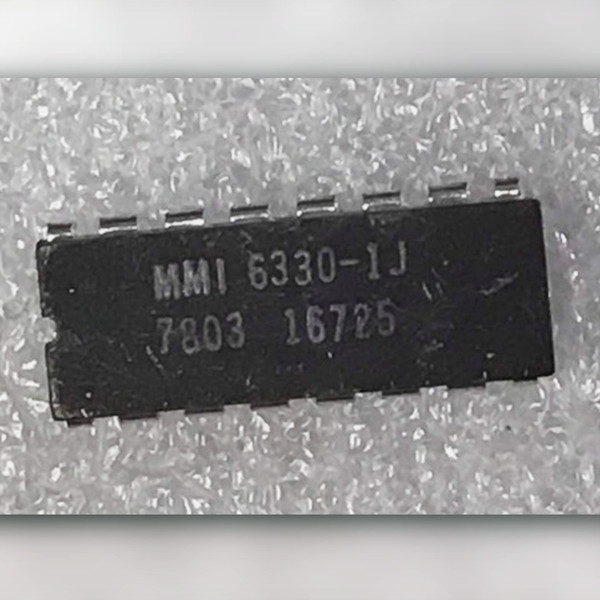
Condition is New. No solder appears anywhere on the leads in the photographs, and nothing in frame reads as a part that has been seated and pulled. Stock is one, so the chip in these three photos is the chip that ships. Photo 1 shows the top of the black ceramic body with the marking still crisp: MMI 6330-1J on the first line, 7803 16725 on the second. Photo 2 is an edge view; the leads on that row sit at slightly uneven angles and will want gentle straightening before they drop cleanly into a socket or a through-hole pattern. Photo 3 shows the underside, both rows of eight present, with a partial 330 marking legible. We do not power up, read, or program-test parts like this, so the fuse state of the array is not verified.
Same or next business day shipping from our Idaho warehouse. Honest pricing, no nonsense.
Online since 1999. We are here for our customers, with a no-hassle satisfaction guarantee.
Product Overview
This is a single MMI 6330-1J, a 256-bit bipolar PROM organized 32 words by 8 bits in a 16-pin ceramic dual inline package. MMI is Monolithic Memories Inc., the Sunnyvale company that helped define bipolar programmable logic before it was absorbed by AMD in 1987, and the mark on the top of this package is theirs. The 6330 family is fusible-link, one-time programmable: you burn the pattern once with a device programmer and it stays burned. In MMI's numbering the 5330 carried the military temperature range and the 6330 the commercial range; the J suffix denotes the ceramic package, and the -1 denotes the faster speed selection within the type. The exact access time for the -1 grade and the output structure are not confirmed here - verify against the datasheet before use. The part reads MMI 6330-1J over 7803 16725, where 7803 reads as a date code for week 3 of 1978 and 16725 as a lot or trace code. The previous listing called this a 1980 part; the marking on the piece itself says otherwise, and we went with the marking.
Key Features
- Marked MMI 6330-1J, second line 7803 16725; 7803 reads as week 3 of 1978
- 256-bit bipolar PROM, organized 32 words by 8 bits
- Fusible-link, one-time programmable; requires a programmer that supports bipolar PROMs
- 16-pin ceramic dual inline package, two rows of eight leads; row spacing not measured here - confirm against your socket or footprint
- J suffix indicates the ceramic package; -1 indicates the faster speed selection
- Bipolar TTL-family device built around a 5 V supply; exact timing, current, and output specs not confirmed - verify against the datasheet before use
- Stock of one; the photographed chip is the chip that ships
- Sold untested; whether the array is blank or already programmed has not been verified
Applications
- Restoring a late-1970s or early-1980s minicomputer, terminal, or arcade board where a 32 by 8 PROM sits in an address decoder, character generator, or state map, and you want a period-correct spare on the bench.
- Keeping a piece of legacy production test gear running when the original decode PROM has gone unreliable and the repair calls for the same family rather than a modern substitute.
- Burning a small lookup table or sequencer map on a device programmer that still supports bipolar fusible-link parts, using a candidate device you can afford to learn on.
- Collecting or documenting pre-AMD Monolithic Memories silicon, where a clearly marked and dated ceramic package is the point.
Frequently Asked Questions
What does a 6330 actually do?
It is a small bipolar PROM: 32 addressable words, 8 bits wide, 256 bits total. Bipolar PROMs were the fast, simple way to store a decode table, a character set, or a hard-wired state machine in an era when that logic otherwise cost you a handful of gate packages.
What do the two lines of marking mean?
The first line, MMI 6330-1J, is the maker's mark and the full type designation with the speed selection and the ceramic package suffix. The second line, 7803 16725, is a date code and a lot code. 7803 reads as week 3 of 1978, which makes this an older part than the previous title claimed.
Is it blank, or has it already been programmed?
Not verified. We did not read this device. It is a one-time-programmable fusible-link part, so if your work depends on a confirmed blank array, plan on reading it in your programmer before you commit a pattern to it.
Do the leads need attention before installation?
Look at photo 2. One row sits at slightly uneven angles. A lead straightener, or a careful pinch between two flat surfaces, should bring the rows parallel. Nothing is bent flat against the body and no lead is missing.
What am I taking on with a 1978 PROM that is sold untested?
Straight answer: the condition ruling is New and unused, nothing in the photos reads as an installed and removed part, and there is exactly one of these. What you are absorbing is that we do not power it up, read it, or verify the fuse array. The photos and the markings are the spec, and they were shot from the top, the edge, and the underside so you can judge for yourself before you buy. If it shows up as something other than what you see here, the no-hassle guarantee covers you. Shipping is a flat $8, free once your order passes $28, and orders leave the Idaho warehouse the same or next business day.
MMI built these little 32 by 8 arrays back when a lookup table was something you burned once and lived with, and this one still wears its 7803 date code in plain sight. Where it goes next, a decoder, a character map, or a restoration that has been waiting on the right sixteen pins, is your call.