

Product Overview
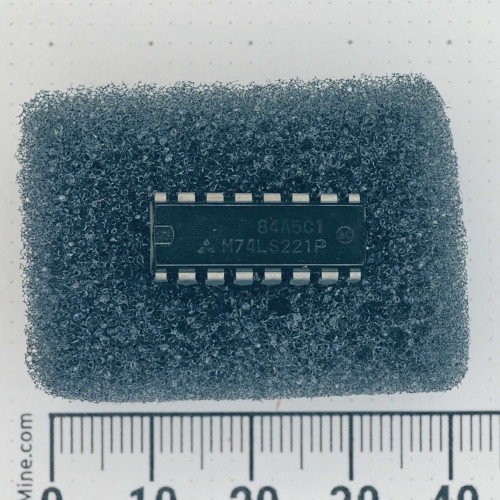
Motorola MC14528 CMOS Dual Retriggerable Resettable One-Shot IC
Condition
Unused new old stock (NOS). Sold each. Leads are straight and the molded body is clean with legible Motorola markings.
Same or next business day shipping from our Idaho warehouse. Reliable parts since 1999. Honest pricing, no nonsense.
We are here for our customers, with a no-hassle satisfaction guarantee.
Product Overview
Built on B-series CMOS technology, the Motorola MC14528BCP dual retriggerable, resettable monostable multivibrator provides two independent one-shot timing circuits in a single 16-pin package. Each section produces an accurate output pulse width controlled by external timing components. Operating across a wide 3.0 V to 18 V supply range with buffered complementary outputs, it provides reliable pulse-shaping and timing control in industrial logic and digital circuits.
Key Features
- Dual independent retriggerable and resettable multivibrators in a single package
- Supply voltage range of 3.0 V to 18 V DC
- Leading-edge or trailing-edge triggering flexibility
- Independent reset input overrides triggers to terminate the output pulse immediately
- Buffered complementary Q and active-low Q outputs
- Standard 16-pin dual in-line package (PDIP-16)
Applications
- Bench prototyping and precision pulse stretching in maker projects
- Hardware switch-debounce and delay timing in industrial machinery controls
- Direct board repair for vintage digital synthesizers, pinball controllers, and test instruments
Frequently Asked Questions
Is the MC14528BCP pin-compatible with other standard CMOS multivibrators?
The MC14528BCP shares the industry-standard 16-pin layout with the CD4528B and MC14538B logic devices. Verify external RC network values to match desired pulse durations.
How many independent timing circuits are contained in one IC?
Each MC14528BCP contains two complete, independent monostable multivibrators, providing two separate timing channels from one DIP-16 chip.
Nothing quite matches the reliable snap of a dedicated hardware one-shot when writing software timers is pure overkill. Keep the breadboard running and the legacy timing loops right where they belong.