

Product Overview
Burr Brown ADC71JG 16-Bit A/D Converter in a Gold-Lead Ceramic 32-Pin DIP
Condition
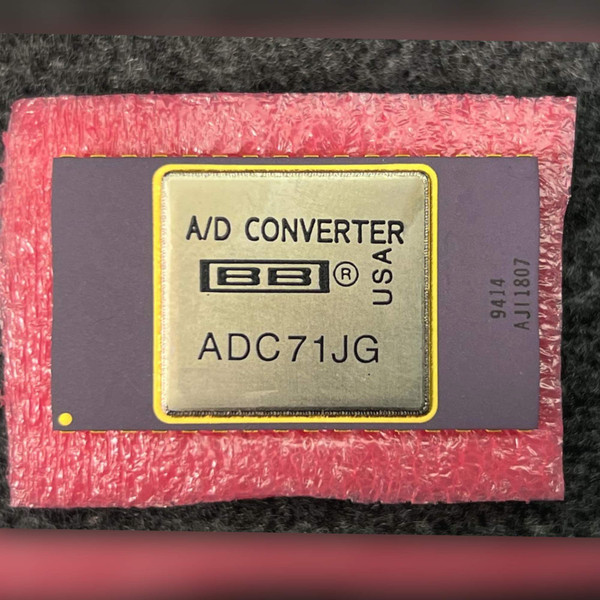
Used. Pulled from a socket in decommissioned lab equipment, clean and guaranteed functional. We only remove integrated circuits that sit in sockets, not parts soldered straight to a board, so bright unmarked pins are simply what a used pull looks like coming off our shelf. The photographs show a plum-colored hermetic ceramic body with a gold-plated lid carrying the Burr Brown BB logo with USA beside it and the type number ADC71JG. Two different pieces were photographed and their lids are not identical: one reads A-D CONVERTER with a hyphen and carries the date code 9433AJI3741 on the lid itself, while the other reads A/D CONVERTER with a forward slash, carries no date code on the lid, and is marked 9414 AJI1807 on the ceramic flank. Both are 1994 production. Gold-plated leads are straight, bright and complete along both rows, with no bends, no corrosion and no solder residue. A gold dot marks pin 1 at one corner. Parts are shown resting on pink antistatic foam. Three pieces are in stock, so the date code on the piece you receive may not match the photographed unit exactly.
Same or next business day shipping from our Idaho warehouse. Honest pricing, no nonsense.
Online since 1999. We are here for our customers, with a no-hassle satisfaction guarantee.
Product Overview
The Burr Brown ADC71JG is a 16-bit analog to digital converter built as a hybrid module inside a 32-pin side-brazed ceramic DIP, the package style collectors and buyers usually write as CDIP-32. This is the gold-lead, gold-lid version, the format Burr Brown used when a converter had to survive in instrumentation rather than consumer hardware, and the lid on these pieces is marked USA. The units here carry 1994 date codes and came out of sockets in lab equipment that was taken out of service, which is the usual way an obsolete 16-bit converter of this class reaches a surplus shelf at all. Buyers searching for it also write the type as ADC71, ADC-71 and ADC71 JG. Electrical parameters are not printed on the package, so treat the datasheet as the authority for input ranges, conversion time, linearity and supply requirements before you drop one into a design.
Key Features
- Resolution: 16-bit analog to digital converter
- Package: 32-pin hermetic ceramic DIP with leads brazed along the sides of the body
- Leads: gold plated, straight and complete, with no solder residue, as expected on a converter lifted out of a socket
- Lid marking: BB logo, USA and ADC71JG on both photographed pieces, with the descriptor reading A-D CONVERTER on one and A/D CONVERTER on the other
- Date codes observed in photos: 9433AJI3741 on one piece's lid and 9414 AJI1807 on another piece's ceramic flank, both 1994
- Pin 1 indicated by a gold dot at one corner of the ceramic
- Condition: used, pulled from a socket in decommissioned lab equipment, clean and guaranteed functional
- Stock on hand: 3 pieces, date codes vary piece to piece
- Input ranges, conversion time, linearity and supply voltages: Not confirmed - verify against the ADC71 datasheet before use
Applications
- Instrument technician repairing a 1990s data acquisition chassis whose original 16-bit converter has failed
- Test engineer keeping a legacy strain gauge or weighing rack in service without redesigning the analog board
- Depot maintenance shop stocking spares for equipment whose converter is no longer available new
- Restorer or experimenter socketing a gold-lead ceramic 16-bit converter on a bench project
Frequently Asked Questions
Will my piece carry the same date code as the one in the photos?
Not necessarily. Three pieces are in stock and the photographed units already differ, one lid reading 9433AJI3741 and another piece carrying 9414 AJI1807 on its ceramic flank with no date code on the lid at all. The lid text differs between them too, A-D CONVERTER on one and A/D CONVERTER on the other, though both are 1994 production. If you need a specific date code for a matched build, ask before ordering.
If this is used, why is there no solder on the leads?
Because it came out of a socket. Standing practice in our warehouse is to pull integrated circuits that sit in sockets and leave the ones soldered directly to a board where they are, so a used IC off our shelf normally arrives with clean, untinned, untrimmed pins. Both rows here are straight, bright and uniform, just as they left the socket. The grade is still used, removed from decommissioned lab equipment.
Which specifications can you confirm?
Only what the part and the photographs carry: 16-bit resolution, the 32-pin gold-lead ceramic DIP package, the Burr Brown branding, the USA lid marking and the 1994 date codes. Input range, conversion time, linearity error and supply current are not confirmed here. Verify them against the ADC71 datasheet before committing the part to a design.
It came out of lab equipment. What am I actually getting, and what am I taking on?
You are getting a used 16-bit converter lifted from a socket in decommissioned lab gear, described as clean and guaranteed functional, in the condition the photographs show: intact ceramic, sound gold lid, straight gold leads, legible markings. What is not included is a datasheet-level bench report, since we do not run accuracy or linearity sweeps on a converter of this vintage. The photographs and the markings are the spec, you verify performance in your own circuit, and the no-hassle satisfaction guarantee covers you if the part does not turn out as described. This one clears the free shipping line on its own, and orders leave the Idaho warehouse the same or next business day.
In 1994 sixteen clean bits still cost real money, so Burr Brown sealed them under a gold lid instead of a plastic body. If a lab instrument on your bench is still waiting on that exact converter, the next chapter is yours to socket in.