


Product Overview
Burle 4856 Head-On Photomultiplier Tube, 51mm Bialkali Window, Unused in the Original Carton
Condition
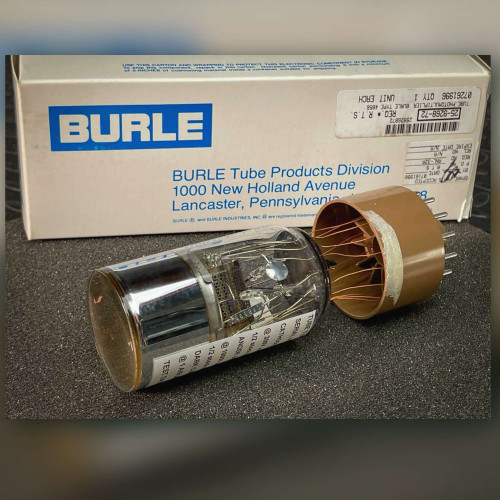
Unused, new old stock, clean and in excellent condition. The photographs show the tube out of its Burle Tube Products Division carton, resting on foam. The Burle factory test label is still wrapped around the glass and reads TUBE TYPE 4856, SERIAL NO C72393, CATHODE SENS 10.2 uA/BLM at 300V and 100 ulumens on a CS5-58 half stock thickness filter, ANODE SENS 4.8 A/BLM at 1000V and .1 ulumens, DARK CURRENT 0.8 nA at 820 volts, TEST DATE 4/30/96. The carton carries two separate 1996 labels: a barcode stock label reading 25-9268-72, TUBE.PHOTOMULTIPLIER BURLE TYPE 4856, REQ.# R.T.S., 07261996 QTY 1 UNIT EACH, and above it a SPARE PARTS ACCEPTED label with P.O. NO. R.T.S., REQ. NO. ANL-32A, ACL NO N/A, EXPIRE DATE N/A and DATE 07161996. In the photos the glass is clear, the mirrored getter deposit is intact, the internal serial tag C72393 is legible through the envelope, and the 14 pin base is clean with straight, bright pins and molded pin numbers 1 through 14. Several photos show the brown 14 pin base shell slid back from the glass neck so the copper lead wires between the stem and the pins are visible, with the factory adhesive strip still inside the shell. Stock is 4 and the figures above are read from the label on the tube photographed, so they describe that unit only; we have not documented the labels on the other three. The electrical data we can point to is that factory label, not a bench test of our own.
Same or next business day shipping from our Idaho warehouse. Honest pricing, no nonsense.
Online since 1999. We are here for our customers, with a no-hassle satisfaction guarantee.
Product Overview
The Burle 4856 is a head-on photomultiplier tube built by Burle, formerly RCA, in Lancaster, Pennsylvania. Light enters through a flat 51mm (2 inch) lime glass end window rather than the side of the envelope, which is why head-on tubes get used where the source, the scintillator, or the sample cell sits directly in front of the detector. Behind that window sits a K2CsSb bialkali photocathode with a 300 to 650 nanometer spectral response, feeding a 10 stage dynode chain that the photos show as a gold-colored mesh cage supported on white ceramic insulators, with the anode structure and getter clearly visible through the clear glass. The tube terminates in a 14 pin base with molded pin numbering. The original listing notes performance characteristics comparable to a Hamamatsu R2154-02. The tube photographed carries its own Burle test label recording cathode sensitivity, anode sensitivity, dark current and the date the factory measured them; that one unit is the only one we have documented, so we make no promise about labels on the rest of the stock.
Key Features
- Type: Burle (formerly RCA) 4856 head-on photomultiplier tube
- Spectral response: 300 to 650 nm
- Photocathode material: K2CsSb bialkali
- End window: lime glass, 51mm / 2 inch diameter, flat head-on face
- Dynode stages: 10
- Base: 14 pin, molded pin numbers, straight pins in the photos
- Comparable performance to a Hamamatsu R2154-02 per the original listing
- Factory test label on the unit photographed: serial C72393, cathode sensitivity 10.2 uA/BLM at 300V, anode sensitivity 4.8 A/BLM at 1000V, dark current 0.8 nA at 820 volts, tested 4/30/96
- Supplied in the original Burle carton with its 1996 receiving label
Applications
- Physics lab technician rebuilding a scintillation counter head that needs a blue-sensitive head-on tube behind the crystal
- Instrument builder assembling a bench photon counting or spectrofluorometer detector and matching a 14 pin socket to a 10 stage divider chain
- Process control engineer keeping an opacity, color or thickness gauge alive where a scintillator and a photomultiplier read transmitted or reflected light
- Service tech maintaining older radioimmunoassay and gamma counting instruments built around a 2 inch head-on PMT
Frequently Asked Questions
What do the numbers on the factory test label actually mean?
They are Burle's own measurements on that specific tube at the factory. Cathode sensitivity 10.2 uA/BLM was read at 300V with 100 microlumens through a CS5-58 half stock thickness filter, anode sensitivity 4.8 A/BLM at 1000V with .1 microlumens through the same filter, and dark current 0.8 nA at 820 volts, all dated 4/30/96. Use them as the factory's starting point for your divider design, not as a guarantee of present-day performance after three decades in storage.
Is this a drop-in replacement for a Hamamatsu R2154-02?
The original listing describes the 4856 as having performance characteristics comparable to an R2154-02. Comparable is not the same as interchangeable. Check window size, pin arrangement and the voltage divider your instrument expects against both datasheets before you commit to the swap.
Does it include a socket, a voltage divider or a mu-metal shield?
What the photographs show is what is pictured: the tube itself and the Burle carton it came in. No socket, divider chain, magnetic shield or housing appears in any photo, so plan on supplying your own 14 pin socket and dynode divider, and ask us first if you need something beyond the tube.
How should a glass tube like this be handled and shipped?
The carton itself prints the instruction: use this carton and wrapping to protect the component in storage, repack in this carton to ship it, and overpack with a minimum of two inches of cushioning inside a suitable outer container. That is the standard this tube travels by. Handle the end window by the edges, keep it dark and dry, and do not apply high voltage with the photocathode exposed to room light.
It is unused stock from 1996, so what am I actually taking on?
You are getting the tube in these photographs: unused new old stock in its Burle carton, glass clear, getter mirror intact, pins straight, factory test label still on the envelope. What does not come with it is a fresh reading, so that 4/30/96 label and these photos are the spec. Bring your own divider chain and a dark enclosure, ramp the high voltage up slowly on a tube that has been on a shelf this long, and inspect it before you trust it in an experiment. This one clears the free shipping line on its own, and orders leave the Idaho warehouse the same or next business day.
Signed off in Lancaster on the last day of April 1996, boxed as a spare that never got called, this bialkali tube has spent three decades waiting to count its first photon. Give it a clean divider chain and a dark box, and the rest of the story is yours.