

Product Overview
High-Output T-1 3/4 Red Indicator Diode for Breadboards and Panel Bezels
Condition
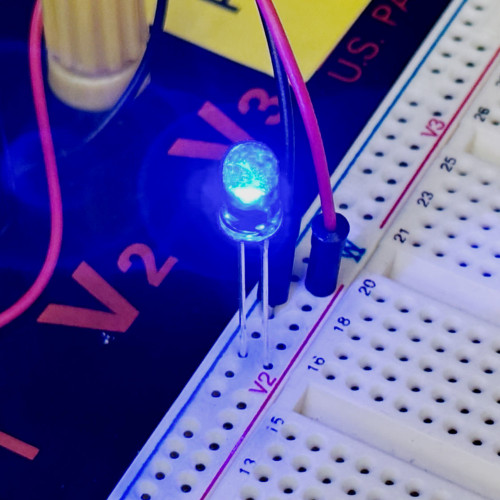
Unused new old stock (NOS). Leads are straight, untrimmed, and clean with no solder residue or oxidation. The clear epoxy dome is intact with no cracks or clouding. Powered breadboard testing confirms bright red illumination.
Same or next business day shipping from our Idaho warehouse. Reliable parts since 1999. Honest pricing, no nonsense.
We are here for our customers, with a no-hassle satisfaction guarantee.
Product Overview
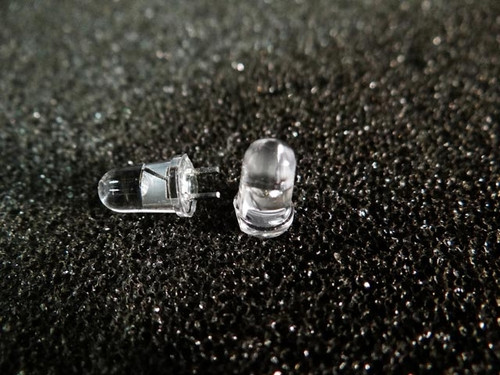
A standard 5mm (T-1 3/4) through-hole component, this emitter pairs an uncolored water-clear epoxy dome with a high-brightness red die. Because the lens carries no tint or internal diffusion, it remains completely clear when unpowered and throws a focused, saturated red beam when energized at its standard 20 mA operating current.
Key Features
- Standard T-1 3/4 (5mm) radial through-hole package format
- Water-clear non-diffused epoxy dome lens
- Saturated red light emission rated at 6000 to 7000 mcd output
- Forward operating voltage of 3.0 to 3.4 VDC at 20 mA forward current
- Two untrimmed radial leads with standard 0.1-inch (2.54 mm) pin spacing
- Cathode identified by shorter lead and flat edge on body rim
Applications
- Prototyping status indicators on solderless breadboards and perfboards
- Installing high-visibility red indicators into custom electronics enclosures and front-panel bezels
- Building scale model lighting, tabletop gaming scenery, and custom illuminated costume props
- Replacing failed status LEDs in audio gear, power supplies, and vintage test equipment
Frequently Asked Questions
Does this LED require a current-limiting resistor?
Yes. Like standard through-hole LEDs, it requires an external series resistor matched to your supply voltage and the 20 mA operating current to prevent burnout.
How is polarity identified on the leads?
The longer lead is the anode (positive terminal), and the shorter lead next to the flat rim on the base of the epoxy dome is the cathode (negative terminal).
Can I buy just a few LEDs, or do I have to purchase a full bulk lot?
You can purchase the exact count needed for your build or bench repair without committing to a surplus pack. More pieces cost less each, and the price-break table on this page shows what each quantity costs. Orders ship for an $8 flat rate, ship free once the order passes $28, and leave our Idaho warehouse the same or next business day.
A water-clear dome hides its color until you flip the switch, turning a plain clear bead into a bright red focal point. Solder it in, drop the right resistor behind it, and let your circuit speak for itself.