

Product Overview
PNP Silicon Bipolar Switching Transistor in TO-106 Package
Condition
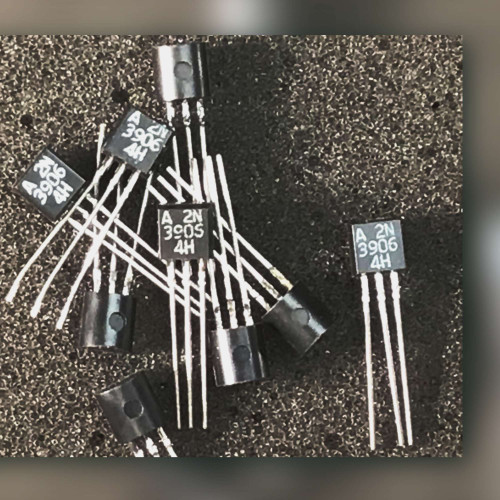
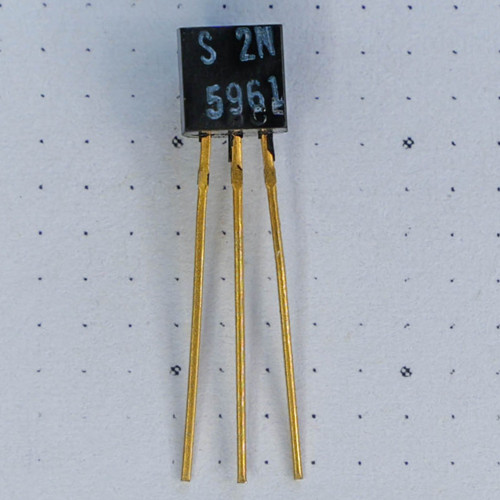
Unused new old stock (NOS). Solid leads with clean tinning and no signs of prior installation. Markings legible: 2N3640. Sold each.
Same or next business day shipping from our Idaho warehouse. Reliable parts since 1999. Honest pricing, no nonsense.
We are here for our customers, with a no-hassle satisfaction guarantee.
Product Overview
The 2N3640 is a silicon PNP bipolar junction transistor housed in a molded plastic TO-106 package. Built for high-speed saturated switching and high-frequency amplification, it handles collector currents up to 80 mA with a 500 MHz transition frequency.
Key Features
- Transistor polarity: PNP silicon
- Collector-emitter breakdown voltage (Vceo): 12 V
- Collector-base breakdown voltage (Vcbo): 12 V
- Emitter-base breakdown voltage (Vebo): 4 V
- Continuous collector current (Ic): 80 mA
- Power dissipation (Pd): 200 mW
- Transition frequency (fT): 500 MHz
- Package style: TO-106 through-hole with 3 wire leads
Applications
- High-speed digital logic switching circuits and pulse generators
- VHF and UHF oscillator, mixer, or RF driver stages
- Restoring vintage test gear, synthesizers, and legacy equipment requiring TO-106 components
- Prototyping breadboard circuits that require fast small-signal PNP switching
Frequently Asked Questions
What is the transition frequency rating of the 2N3640?
The 2N3640 features a transition frequency (fT) of 500 MHz, making it suitable for high-speed switching and high-frequency signal processing.
What package type does this transistor use?
This component uses a plastic molded TO-106 through-hole package with three wire leads.
Can the 2N3640 be used in place of standard general-purpose PNP transistors?
The 2N3640 is specifically optimized for high-speed switching up to 500 MHz with a 12V breakdown rating, rather than higher-voltage audio or low-frequency general-purpose amplification.
Fast switching never really goes out of style, even when it comes in an older package. Drop this little silicon PNP into your circuit and let it snap those pulses into shape.