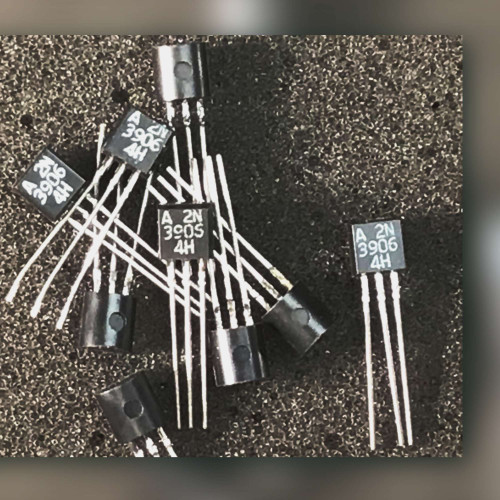


Product Overview
Motorola M9571 / 48-869571 Silicon Small-Signal BJT in TO-92
Condition
Sold each. Unused new old stock (NOS) in clean cosmetic condition with straight, untrimmed through-hole leads. Markings legible: 9571 with Motorola emblem.
Same or next business day shipping from our Idaho warehouse. Reliable parts since 1999. Honest pricing, no nonsense.
We are here for our customers, with a no-hassle satisfaction guarantee.
Product Overview
Built for audio muting, preamplification, and switching stages, Motorola part number 9571 (catalog 48-869571, also documented as M9571) is a silicon PNP small-signal bipolar junction transistor in a TO-92 plastic package. Originally specified across Motorola land-mobile communications gear, including MICOR stations and Starplex channel modems, it handles small-signal tasks in legacy radio and telecommunications hardware.
Key Features
- Silicon PNP small-signal bipolar junction transistor (BJT)
- Classic 3-pin through-hole TO-92 plastic package
- Motorola house part number 48-869571 (body marked 9571)
- Common service equivalent to 2N3906 and MPS3703 devices
- Suitable for analog audio amplification, buffering, and low-power switching
Applications
- Servicing legacy Motorola two-way radio base stations, repeaters, and metering cards
- Maintaining telecommunications channel modems and analog signaling hardware
- Building DIY analog synthesizer modules, audio preamps, and muting subcircuits
Frequently Asked Questions
What industry-standard transistors cross-reference to the Motorola 9571?
Motorola service documentation and component replacement guides cross-reference part number 48-869571 (type M9571) to standard general-purpose PNP transistors, specifically the 2N3906 and MPS3703.
What package style does this transistor use?
It is housed in a standard 3-lead plastic TO-92 through-hole package with straight leads.
What type of circuit is this PNP transistor best suited for?
It is designed for small-signal audio amplification, signal buffering, and low-power switching stages. Each piece costs less as the order grows - see the price-break table on this page.
Before entire circuits disappeared into surface-mount chips, bench techs kept two-way radio networks running with honest through-hole transistors like this. Solder it into place, trim the leads, and let the circuit get back to work.