

Product Overview
Heimann LHI 968 Dual-Element Pyroelectric Infrared Detector, 3-Lead TO-5 Can with FET Output for Motion and Intrusion Sensing
Condition
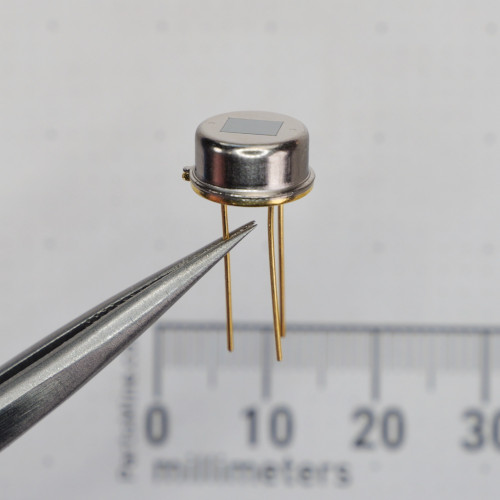
Unused, new old stock (NOS). Markings legible on the lid: HEIMANN, LHI 968, 3866, 0438. Three straight, evenly spaced leads and a clean rectangular filter window. Sold each.
Ships same or next business day from our Idaho warehouse. Honest pricing, no nonsense.
Online since 1999. Satisfaction guaranteed, every time.
Product Overview
Dual-element pyroelectric infrared (PIR) detector, part number LHI 968/3866, in a 3-lead TO-5 metal can with an integral rectangular IR filter window. The lid carries the Heimann mark; Heimann was a brand of PerkinElmer Optoelectronics. Two pyroelectric ceramic elements feed an internal FET source follower, the standard front end for passive infrared motion detectors and intrusion alarms.
Key Features
- Dual pyroelectric ceramic elements with internal FET source follower
- Field of view 100° horizontal x 100° vertical, unobstructed
- Responsivity 3.3 kV/W minimum, 4.0 kV/W typical at 1 Hz
- Integrated RF/EMI suppression network
- White Light Immunity (WLI) optical filter
- TO-5 metal can, 3 wire leads: Drain, Source, Ground
Applications
- Swapping the detector in a hallway or doorway motion sensor whose original PIR can has failed or gone noisy.
- Rebuilding the head of an intrusion alarm detector during a security panel service call.
- Breadboarding a motion-triggered light, wildlife camera trigger or occupancy counter with an op amp stage and a Fresnel lens.
- Building a desk-side presence sensor that wakes a display or logs room activity from a microcontroller.
Frequently Asked Questions
Does it need a lens?
The bare window responds to moving heat across a 100° x 100° field of view. Most motion detector designs add a Fresnel lens in front of the window to extend range and break the view into zones. No lens is included.
Is the output ready to drive a logic input?
No. The internal FET is a source follower that buffers the small signal from the elements. A typical PIR circuit follows it with an amplifier and comparator stage before any logic or relay.
How do I tell this part apart from look-alike PIR cans?
The lid is stamped HEIMANN, LHI 968 and 3866 around a rectangular filter window, on a flanged TO-5 header with three leads.
Every motion light that clicks on when someone walks past starts with a little can like this one, watching for warmth that moves. Give it a lens and an op amp, and it will notice whoever walks into your next project.