

Product Overview
Econistor 8E16 Series 12.5 Ohm Ultra-Precision Axial Wirewound Resistor, 0.1% Tolerance, ±5 ppm/°C TCR
Condition
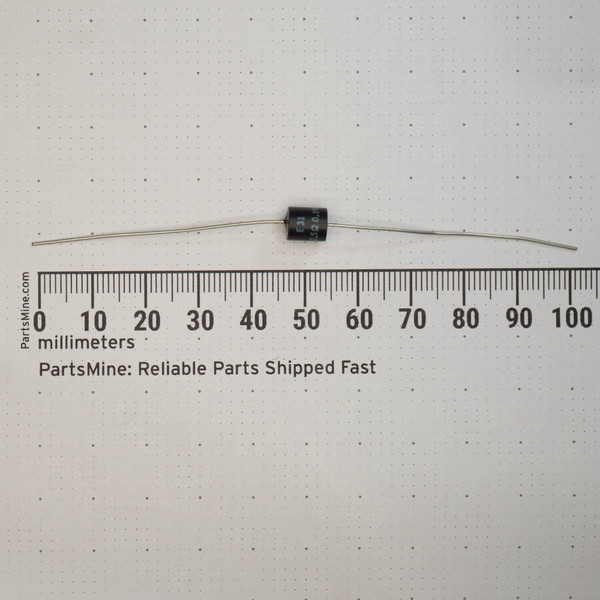
Unused NOS. Visually clean and pristine with no signs of use or damage. Blue text markings on the black epoxy body are clear and legible - photo observations confirm E31 markings and 12.5Ω 0.1% as stamped. Both axial leads are straight and undamaged. Sourced from an electronics distributor consolidating inventory.
Same business day shipping from our Idaho warehouse. Honest pricing, no nonsense.
Online since 1999. We are here for our customers, with a no-hassle satisfaction guarantee.
Product Overview
Econistor 8E16-12.5-D - a vintage ultra-precision wirewound resistor from the General Resistance / Prime Technology legacy line. Resistance value is 12.5 ohms with a 0.1% tolerance (tolerance code D in the General Resistance catalog system). The 8E16 series designation identifies the physical body size: 12.70 mm maximum length, axial lead package. Construction is precision wirewound - a specialized resistive alloy wire wound around a ceramic mandrel and encapsulated in a rugged moisture-resistant epoxy cylinder. Windings are balanced multiple-pi and non-inductively wound for low reactance. The result is a component engineered for long-term stability, minimal temperature drift, and essentially non-measurable noise - the characteristics that define a calibration-grade resistor.
Key Features
- Resistance: 12.5 ohms
- Tolerance: 0.1% (General Resistance code D)
- TCR: ±5 ppm/°C maximum over -55°C to +125°C; ±3 ppm/°C typical over 0°C to +85°C
- Power rating: 0.33W at +85°C
- Maximum continuous working voltage: up to 250V DC or peak
- Operating temperature range: -55°C to +160°C
- Stability: ±35 ppm per 10,000 hours at full load; ±25 ppm per 10,000 hours at no load
- Thermal EMF: less than 0.4 µV/°C typical, less than 1.5 µV/°C maximum
- Noise: essentially non-measurable
- Construction: non-inductively wound precision wirewound, ceramic mandrel, epoxy encapsulation
- Package: axial lead, 12.70 mm body length
- Series: 8E16 (General Resistance / Econistor); face stamp markings E31 and 12.5Ω 0.1% confirmed by photo
Applications
- Calibration technician integrating a stable reference into a bridge circuit to verify multimeter or instrument accuracy against a known 12.5-ohm standard
- Metrology engineer building a precision voltage divider where resistance drift over temperature and time would compound measurement error
- Vintage audio repair tech replacing a failed precision resistor in a high-fidelity attenuator where signal level accuracy and low noise matter more than cost
- Audiophile builder wiring a passive attenuator for a tube preamp or stepped volume control and specifying wirewound for minimum noise floor contribution
- Aerospace or industrial electronics tech maintaining a control loop or sensing circuit that must hold its calibration point across a wide operating temperature range
- Maker or experimenter building a precision Wheatstone bridge, RTD simulation circuit, or any analog measurement application where a stable low-value reference resistance is the keystone
Frequently Asked Questions
Is this the same part whether I search by 8E16-12.5-D or E31-12.5-0.1?
Yes. The official General Resistance catalog string is 8E16-12.5-D. The face stamp on the epoxy body reads E31 with 12.5Ω and 0.1% - both designations refer to the same component. If you spotted the markings on a board under magnification and typed what you saw, you have found the right listing.
What does the tolerance code D mean?
D is the General Resistance letter code for ±0.1% tolerance. On this part, the 0.1% is also printed directly on the body, so there is no ambiguity.
What is the power rating, and what happens if I exceed it?
The 8E16 series at 0.1% tolerance is rated 0.33W at +85°C ambient. Exceeding that rating does not necessarily destroy the resistor immediately, but it will drive the resistance value outside its specified tolerance window - which defeats the entire purpose of buying a precision part. Size your circuit so dissipation stays comfortably below 0.33W.
Does the non-inductive winding make this suitable for AC measurement circuits?
The balanced multiple-pi non-inductive winding design minimizes parasitic inductance, which is why this series is used in precision instrumentation and bridge circuits. For very high-frequency RF applications, any wirewound construction has residual parasitics that may be a factor. For audio frequencies and precision low-frequency AC measurement work, this construction is well suited.
What are the physical dimensions?
The 8E16 series has a body length of 12.70 mm maximum. Photo observations of this specific unit show the black epoxy body at approximately 7.5 to 8 mm, with axial leads spanning roughly 100 mm total. Verify your board layout against the 12.70 mm maximum body spec before ordering.
A 12.5-ohm reference point built to hold its value through temperature swings, decades of shelf storage, and the scrutiny of a calibration bench - whoever first specified this part knew exactly what they were asking for. Now it is ready for whatever circuit you have been waiting to finish.