

Product Overview
Silicon PIN Photodiode with Visible-Pass Filter, 320-730 nm Range, 5.44 mm² Active Area, Two-Lead Radial
Condition
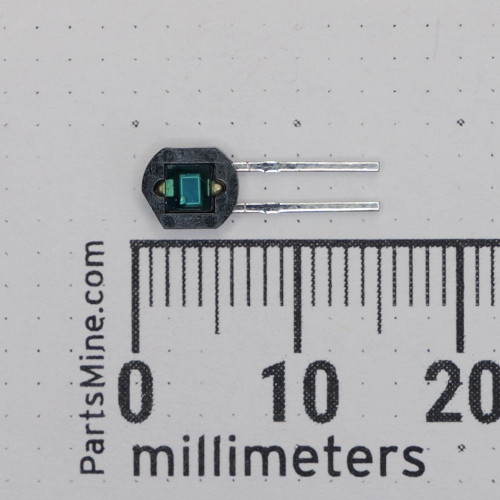
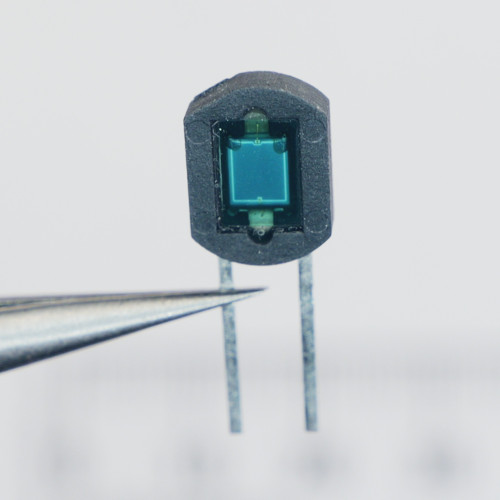
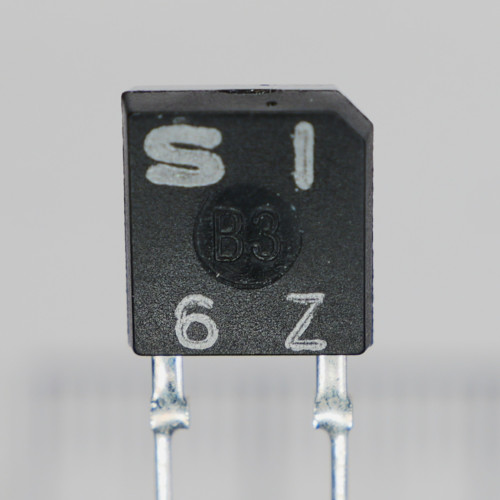
Unused, new old stock (NOS). Two straight gold-colored through-hole leads with no bends, solder or residue. Black two-lead body with a recessed window over the active area and a small index hole beside the window. Sold each.
Ships same or next business day from our Idaho warehouse. Honest pricing, no nonsense.
Online since 1999. A no-hassle satisfaction guarantee on every order.
Product Overview
Built for visible-light measurement, the Photonic Detectors PDV-V417 is a silicon PIN photodiode with an integrated optical filter that passes visible light and blocks infrared. Response peaks at 560 nm across a 320 nm to 730 nm application range. It is designed for photovoltaic operation at 0 V bias in exposure meters and visible detection work.
Key Features
- Silicon PIN photodiode with integrated visible-pass, IR-blocking filter
- Spectral application range 320 nm to 730 nm, peak response 560 nm
- Active area 5.44 mm² (2.51 mm x 2.16 mm)
- Dark current 3 pA typical, 10 pA maximum at VR = 1 V
- Shunt resistance 1.0 GΩ minimum, 1.5 GΩ typical at VR = 10 mV
- Junction capacitance 650 pF typical at VR = 0 V, 1 MHz
- Response time 500 ns typical at RL = 1 kΩ, VR = 10 V
- Viewing angle 100°
- Package 9.00 mm x 6.00 mm x 3.50 mm, two radial through-hole leads at 5.00 mm spacing
- Index hole beside the sensor window marks the cathode lead
Applications
- Replacing the light cell in a handheld or camera exposure meter, run at 0 V bias into the meter's existing amplifier.
- Building a visible-light meter on the bench with an op amp transimpedance stage, where the IR-blocking filter keeps heat lamps and IR sources out of the reading.
- Checking visible LED or lamp output on a test fixture during burn-in or before and after a repair.
- Logging daylight or grow-light levels with a microcontroller in a maker project, with the photodiode feeding an ADC through a simple amplifier.
Frequently Asked Questions
Which lead is the cathode?
The lead on the side of the small index hole next to the sensor window is the cathode.
Does it need a bias voltage?
No. It is designed for photovoltaic operation at 0 V bias, the usual mode in exposure meters. Dark current is rated at 1 V reverse bias and response time at 10 V, so it also runs reverse-biased when speed matters more than low noise.
Will it pick up an IR remote or IR LED?
No. The integrated filter blocks infrared, and the application range ends at 730 nm.
What footprint does it need?
Two through-hole pads 5.00 mm apart, with board space for a 9.00 mm x 6.00 mm body standing 3.50 mm tall.
A 560 nm peak sits close to where the human eye sees green best, which is why a part like this belongs inside a light meter. Drop it into your build and let it read the light the way you see it.