

Product Overview
Sharp BS120 Silicon Photodiode for Camera Exposure and Light Metering - 560 nm Peak, Built-in IR Cut-Off Filter
Condition
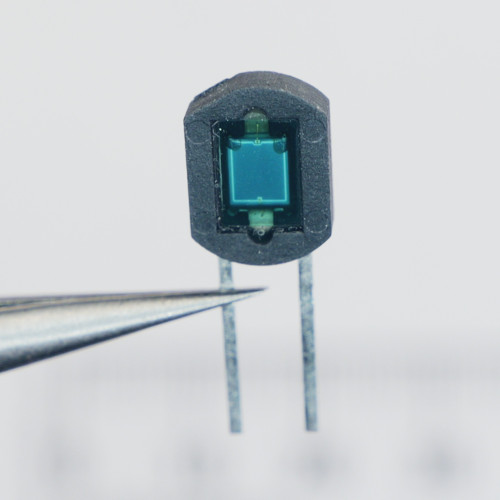
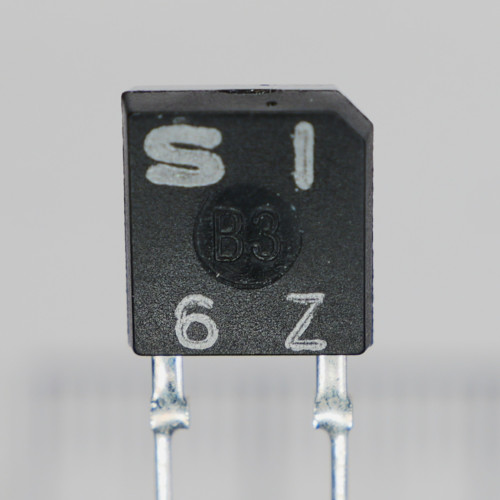
Unused, new old stock (NOS). Markings legible: BS120 SHARP. Black molded flat package with a window over the die and two straight through-hole leads. Sold each.
Ships same or next business day from our Idaho warehouse. Honest pricing, no nonsense.
Online since 1999. Satisfaction guaranteed, every time.
Product Overview
Sharp Microelectronics BS120 is a silicon photodiode built for visible light, with a 560 nm peak sensitivity and a built-in infrared cut-off filter that brings its response close to the human eye. Sharp aimed it at camera automatic exposure and electronic shutter circuits, stroboscopes and precision optical instruments.
Key Features
- Device type: silicon photodiode for visible light
- Peak sensitivity wavelength: 560 nm, matched to human eye spectral response
- Built-in infrared cut-off filter
- Active sensor area: 1.55 mm²
- Maximum reverse voltage (VR): 10 V
- Dark current: 10 pA max at VR = 1 V, 3 pA typical
- Package: 2-pin side-view flat package, through-hole mounting
- Molded rear markings: BS120, SHARP
Applications
- Replacing the exposure-metering photodiode while restoring an auto-exposure film camera.
- Sensing the light level in a strobe or flash circuit that cuts its output once enough light has hit the subject.
- Building a bench lux meter: feed the BS120 into a transimpedance op amp and read a voltage that follows visible light the way an eye sees it.
- Adding ambient light sensing to a maker project so a display or LED strip dims as the room gets dark, without stray IR from remotes throwing it off.
Frequently Asked Questions
Will the BS120 pick up infrared remotes or IR LEDs?
It is built to ignore them. A built-in infrared cut-off filter keeps the response centered on visible light, peaking at 560 nm. For IR detection, a different photodiode is the right part.
How much reverse bias can it take?
10 V maximum reverse voltage. Dark current is 10 pA max at 1 V of reverse bias, 3 pA typical, which keeps low-light readings clean.
Which way does the window face once it is on the board?
BS120 is a side-view part. With both leads in the board, the window faces out sideways, parallel to the board surface, so it looks across the board rather than straight up.
Auto-exposure cameras trusted a sliver of silicon like this to see light the way an eye does and make the call before the shutter moved. Give it an op amp and a reason, and it will make the same call on your bench.