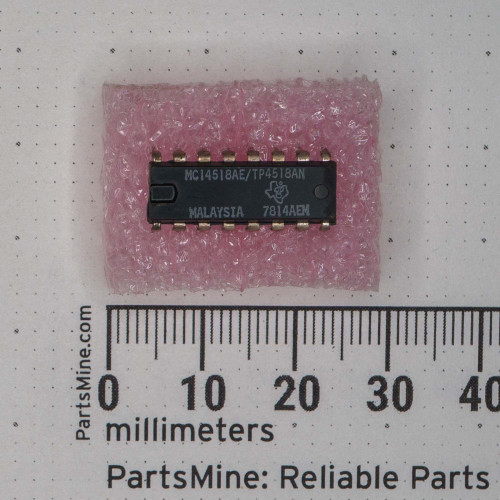


Product Overview
Texas Instruments CC2541 2.4 GHz Bluetooth Low Energy Wireless Microcontroller
Condition
New old stock. Unused surplus in clean physical condition with pristine underside land contacts and ground pad. Markings legible: CC2541 F128 TI. Sold each.
Ships same or next business day from our Idaho warehouse. Honest pricing, no nonsense.
Online since 1999. We are here for our customers, with a no-hassle satisfaction guarantee.
Product Overview
Texas Instruments CC2541F128RHAT is a power-optimized true system-on-chip for 2.4-GHz Bluetooth low energy and proprietary RF applications. It integrates an industry-standard 8051 microcontroller core with 128 kB in-system programmable flash memory, 8 kB of RAM, and an integrated 2.4 GHz RF transceiver into a compact 6 mm by 6 mm 40-pin QFN package.
Key Features
- 2.4-GHz Bluetooth low energy compliant and proprietary RF transceiver
- High-performance, low-power 8051 microcontroller core
- 128 kB in-system programmable flash memory
- 8 kB internal SRAM with data retention across power modes
- Wide supply voltage operating range from 2.0 V to 3.6 V
- 40-pin 6 mm x 6 mm VQFN package (TI package designation RHA)
- Exposed bottom thermal ground pad for efficient heat dissipation and RF grounding
Applications
- Replacing legacy Bluetooth Low Energy microcontrollers during embedded hardware repair and board re-spins
- Building custom 2.4 GHz wireless sensor nodes, beacon transmitters, and automation remotes
- Prototyping low-power wireless HID peripherals and maker IoT projects
Frequently Asked Questions
What package footprint does this CC2541 variant use?
This chip comes in Texas Instruments' 40-pin VQFN package (package designator RHA), measuring 6 mm by 6 mm with 40 perimeter land contacts and a central exposed thermal ground pad.
What supply voltage is required to operate this IC?
The device operates from an input supply voltage range of 2.0 V to 3.6 V.
How does the CC2541F128 differ from the CC2541F256?
The CC2541F128 provides 128 kB of internal flash memory, whereas the F256 variant integrates 256 kB. Both share the identical 40-pin VQFN footprint, 8051 core architecture, and 8 kB SRAM.
Before everything ran on multi-core ARM chips, the 8051 handled Bluetooth LE just fine and ran on a coin cell for months. Drop it onto the pads, flash your stack, and put that low-power link back on the air.