

Product Overview
Motorola SN74LS245N Octal 3-State Bus Transceiver, DIP-20, TTL 5V Logic, Used
Condition
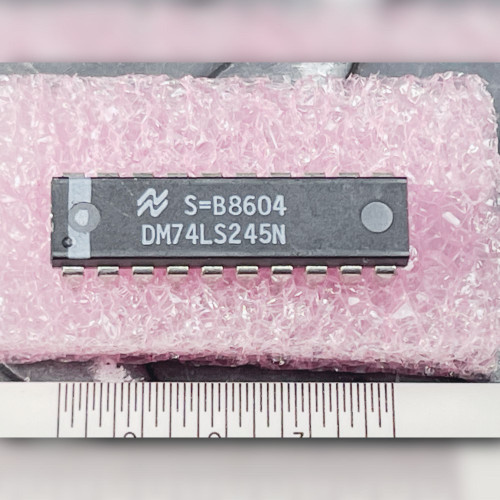
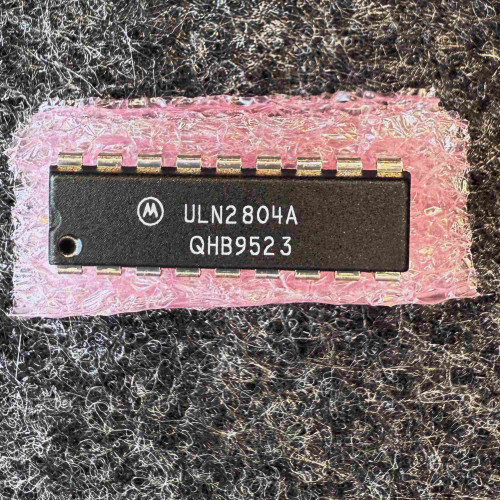
Used and in good condition. Recovered from demanufactured equipment as part of our ongoing recovery from legacy electronics supply chains. Both units show the same date code XAE9510 with Motorola logo clearly visible. Minor surface marks noted on the package face - leads are straight and all 20 pins present. Evaluation: Visual inspection only. Function testing not performed.
Ships same or next business day from our Idaho warehouse. Honest pricing, no nonsense.
Online since 1999. We are here for our customers, with a no-hassle satisfaction guarantee.
Product Overview
Motorola SN74LS245N - octal bus transceiver with 3-state outputs in a 20-pin DIP package. Handles asynchronous two-way communication between 8-bit data buses. A direction input (DIR) controls which way data flows - A-to-B or B-to-A. An output-enable input (OE) can take all outputs to high impedance, effectively isolating the two buses. Operates on standard 5V TTL logic. The PDIP-20 through-hole package fits breadboards and the many vintage PCB footprints originally designed for this part.
Key Features
- 8-channel bidirectional data transfer between two buses
- 3-state outputs - direction control via DIR pin, bus isolation via OE pin
- Logic family: LS (Low-Power Schottky TTL)
- Supply voltage: 4.75V to 5.25V (nominally 5V)
- Propagation delay: 12 ns typical
- Operating temperature: 0°C to +70°C
- Package: PDIP-20 (Plastic Dual In-line Package, 20 pins)
- High-level output current: -15 mA; Low-level output current: 24 mA
- Photo-confirmed markings: SN74LS245N, date code XAE9510, Motorola logo
Applications
- Swapping the SN74LS245N on a vintage computer motherboard or arcade PCB where the original chip has failed - restores data flow between CPU and memory without circuit redesign
- Diagnosing and repairing signal integrity faults on the data bus of industrial control panels or TTL-based test equipment, then verifying the fix with functional diagnostics
- Wiring bidirectional bus communication into a breadboard prototype or custom PCB for a 5V microcontroller project - connect DIR and OE to GPIO pins and control data flow in firmware
- Teaching bus transceiver concepts in a digital electronics lab - the DIP-20 package drops straight into a solderless breadboard and the DIR/OE logic is easy to probe
- Buffering an 8-bit data bus between a microprocessor and peripheral devices such as memory chips, display modules, or expansion boards in retro builds and educational kits
Frequently Asked Questions
Is this compatible with 3.3V logic systems?
No - not directly. The SN74LS245N is specified for a 5V (4.75V to 5.25V) supply and TTL input thresholds. Reliable recognition of a 3.3V logic high is not guaranteed. A level translator is required for interfacing with 3.3V systems.
What package is this - will it fit my PCB?
PDIP-20 - Plastic Dual In-line Package, 20 pins, 0.1-inch pin spacing, 0.3-inch row spacing. This is the standard through-hole DIP footprint used in the original designs this part was built for. Confirm your PCB footprint matches before ordering.
Has this been function tested?
Visual inspection only. Function testing has not been performed. The part is in good physical condition with straight leads and no visible damage - confirm suitability for your application before use.
Is this the commercial or military grade version?
Commercial grade. The SN74LS245N is rated 0°C to +70°C. The military-grade version is the SN54LS245, rated -55°C to +125°C. If your application requires the wider temperature range, this part is not the correct choice.
Is the direction control active high or active low?
DIR high enables A-to-B transmission; DIR low enables B-to-A transmission. The OE input is active low - pull it high to disable (isolate) the bus. This is standard SN74LS245 behavior confirmed by the part number and Motorola markings on this specific unit.
The date code reads 1995 - a chip that has been waiting in a circuit since before most modern dev boards existed. Plug it into the footprint it was designed for and it will do exactly what it was built to do.