

Product Overview
Texas Instruments SN74LS112AN - Dual J-K Negative-Edge-Triggered Flip-Flop, 16-Pin DIP, 5V TTL, 15ns Propagation Delay
Condition
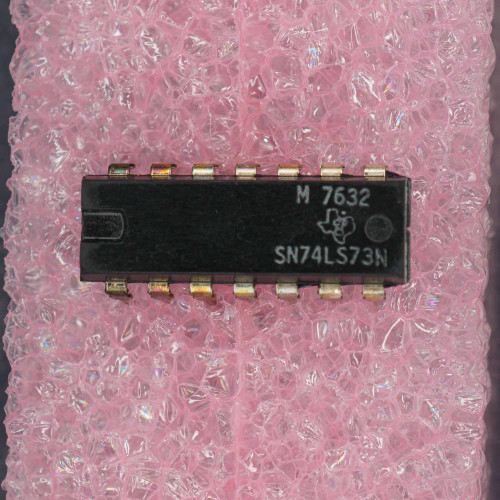
Unused NOS. Markings crisp and fully legible: SN74LS112AN, TI logo, date code 7818, consistent across both sides. Gold-tone leads, no visible damage or oxidation. Sourced from an electronics distributor consolidating inventory. Evaluation: Visual inspection only. Function testing not performed.
Ships same business day from our Idaho warehouse. Reliable parts since 1999. Honest pricing, no nonsense.
We are here for our customers, with a no-hassle satisfaction guarantee.
Product Overview
Texas Instruments SN74LS112AN - a dual J-K negative-edge-triggered flip-flop with independent Preset and Clear inputs on each element, packaged in a 16-pin through-hole DIP. Part of the 74LS (Low-Power Schottky TTL) family, operating on a 5V supply. Each of the two flip-flops is fully independent, with its own J, K, Clock, Preset, and Clear pins. The negative-edge trigger means outputs update on the falling edge of the clock signal. Date code 7818 places manufacture in late 1978 - authentic vintage Texas Instruments production.
Key Features
- Dual independent J-K flip-flops, negative-edge-triggered
- Individual Preset (active-low) and Clear (active-low) inputs on each flip-flop
- Complementary Q and Q-bar outputs per element
- Logic family: Low-Power Schottky TTL (74LS series)
- Supply voltage: 5V (4.75V to 5.25V operating range)
- Typical propagation delay: 15ns
- Maximum toggle frequency: 30 MHz
- Operating temperature range: 0°C to 70°C
- Package: 16-pin PDIP (through-hole), 0.1-inch pitch - breadboard and socket compatible
- TI logo and full part number SN74LS112AN molded and stamped on body; date code 7818 visible
Applications
- Desoldering a failed logic chip from a vintage arcade PCB or retro computer motherboard and dropping this in as a direct pin-compatible replacement - same TTL levels, same propagation delay, same behavior
- Building a divide-by-two or ripple counter on a breadboard for a digital logic course, inserting the DIP directly into the board and probing outputs with an oscilloscope or logic analyzer
- Troubleshooting an industrial control board where a legacy 74LS-family flip-flop has failed - swap and test without redesigning the circuit
- Constructing shift registers or simple state machines for prototyping digital logic sequences before committing to a programmable device
- Stocking a bench supply of 74LS classics for makers who maintain vintage equipment or regularly breadboard TTL-level circuits
Frequently Asked Questions
Is this a direct replacement for a 74LS112 or SN74LS112AN already on my board?
Yes. The SN74LS112AN is the PDIP-16 package variant of the 74LS112A. It is pin-compatible with other manufacturer equivalents in the same package, including DM74LS112AN (Fairchild/National) and equivalent Motorola parts, provided those parts are also the standard commercial temperature range PDIP-16 variant.
What power supply does this require?
5V DC, within a 4.75V to 5.25V range. This is a TTL-family device and is not compatible with 3.3V logic systems without level-shifting.
What is the difference between SN74LS112AN and SN54LS112A?
The SN54LS112A is the military-grade version, rated for -55°C to 125°C. The SN74LS112AN is the commercial version, rated 0°C to 70°C. Both are functionally identical for standard circuit use at room temperature.
Is the SN74LS112AN still manufactured?
The 74LS series is mature - no longer in active production for new designs. NOS stock like this is the primary supply channel for repair and prototyping use. The part is well-documented and widely used in legacy and educational applications.
A late-1978 Texas Instruments flip-flop, crisp and unsoldered after all these decades - the kind of part a bench drawer should have before the circuit needs it, not after.