

Product Overview
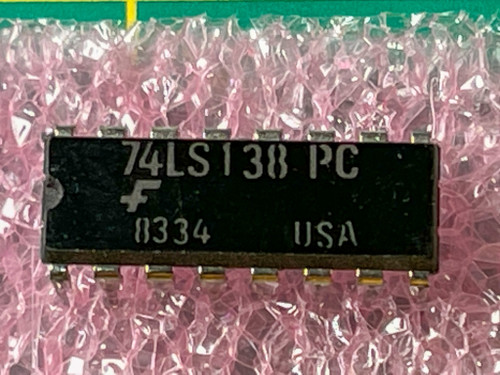
Fairchild 996079 Nixie Decoder/Driver - BCD to Decimal, 16-Pin CerDIP, RTL Logic, 1968 Date Code
Condition
Used condition. Visual inspection passed - ceramic body clean, leads straight, no visible damage. Marked CuL 996079 with Fairchild logo and date code 6843 (week 43 of 1968). Evaluation: Visual inspection only. Function testing not performed. Sourced from legacy electronics supply chains.
Ships same or next business day from our Idaho warehouse. Honest pricing, no nonsense.
Online since 1999. We are here for our customers, with a no-hassle satisfaction guarantee.
Product Overview
Fairchild Semiconductor 996079 - a BCD-to-decimal decoder/driver IC from the Counter Micrologic family, built for direct interfacing between digital logic and Nixie tube displays. Takes a binary-coded decimal input and drives the corresponding cathode on a cold-cathode gas-discharge Nixie tube. RTL (Resistor-Transistor Logic) technology. 16-pin ceramic DIP package. Date code 6843 confirmed by markings - made in 1968.
Key Features
- BCD-to-decimal decoder/driver for Nixie tube displays
- 16-pin CerDIP (Ceramic Dual In-line Package) - confirmed by photo markings
- RTL logic family - supply voltage 3.3V to 5.5V (3.6V typical)
- OFF-state output voltage: 55V minimum - handles Nixie cathode switching
- ON-state output current: 15mA maximum per output
- ON-state output voltage (VoL): 0.4V maximum
- OFF-state output current: 0.6mA maximum per output; total across all 9 outputs not to exceed 1.5mA
- Inverse BCD input logic - inputs are active-low
- Date code 6843 visible on package - period-correct for vintage and restoration builds
Applications
- Nixie clock builder wiring a multi-digit display board - drop one 996079 per tube to handle digit selection from a BCD counter or microcontroller output
- Restoring a vintage frequency counter or digital voltmeter that displays dead or incorrect digits - desolder the failed driver, replace with this original-spec part, verify all digits light cleanly
- Period-accurate instrument restoration where matching the 1968 date code matters - this chip keeps the build honest from the inside out
- Maker building a Nixie-based thermometer, timer, or scorekeeper on a custom PCB - the 996079 simplifies high-voltage digit control without a shift-register stack
- Homelab experimenter studying RTL logic behavior or cold-cathode display driving circuits firsthand
Frequently Asked Questions
Is this compatible with 74141 or K155ID1 Nixie driver circuits?
Functionally similar - all three decode BCD and drive Nixie cathodes. The key difference is logic family: the 996079 is RTL, while the 74141 and K155ID1 are TTL. Input thresholds differ. RTL logic high is 1.0V minimum; TTL is higher. In circuits designed for the 996079 or the original Fairchild 9960, this is a direct replacement. Swapping into a 74141 footprint circuit may require interface verification at the BCD input stage.
What supply voltage does this IC require?
Logic supply (Vcc): 3.3V to 5.5V for operation from 0°C to 75°C; minimum 4.0V for extended operation down to -55°C. The Nixie tube itself requires a separate high-voltage supply - typically 140-170V DC. The 996079 handles the high-voltage cathode switching; the logic supply and HV supply are separate rails.
Do the outputs need to be connected - can any be left floating?
Outputs in the OFF state should not be left floating. Any output not connected to a Nixie tube cathode should be tied to V+ through a 10kΩ resistor. Floating OFF-state outputs can cause erratic behavior.
Is this the actual unit shown in the photos?
Yes. Photos show the specific unit being sold. Markings visible in the photos - CuL 996079, Fairchild logo, date code 6843 - are on the chip you will receive.
Does this come with documentation or a datasheet?
Not included.
A 1968 chip that still knows which digit to light - the date code says it was made when Nixie tubes were the cutting edge, and someone kept it long enough for you to put it to work again. Wire it in, power up the HV rail, and watch a cathode glow orange exactly the way it was always supposed to.