


Product Overview
2-Cell 18650 PCB-Mount Battery Holder with PC Pins - Through-Hole Sled for Custom Battery Packs
Condition
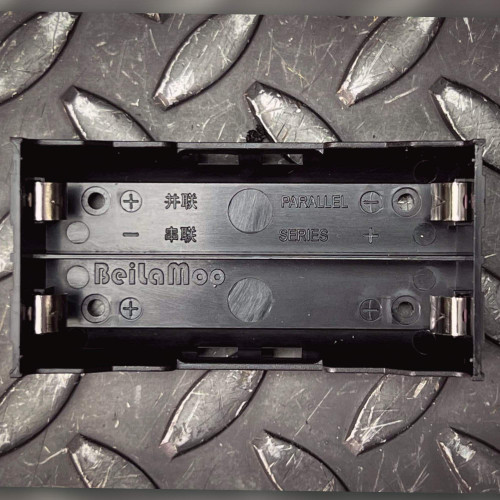
Unused. Molded markings legible: 18650-PC4 and BeilaMoo on body. Four corner mounting holes and metal spring contacts present with no deformation observed. Part of the PartsMine house line, stocked new and sold by the piece.
Same or next business day shipping from our Idaho warehouse. Honest pricing, no nonsense.
Online since 1999. We are here for our customers, with a no-hassle satisfaction guarantee.
Product Overview
BeilaMoo 18650-PC4-flat is a dual-cell through-hole PCB-mount battery holder designed for standard 18650 lithium-ion cells. Metal PC pins solder directly into PCB through-holes, providing a mechanically stable, wire-free connection. Molded internal guides show PARALLEL and SERIES orientation markings in English and Chinese - actual circuit configuration is set by the buyer's PCB trace routing, not the holder itself.
Key Features
- Holds 2 x 18650 lithium-ion cells (3.7V nominal)
- Through-hole PC pin mounting - pins solder directly to PCB, no wire leads
- Pin spacing: 72.50 mm lengthwise x 19.30 mm widthwise
- Overall dimensions: 77.70 mm (L) x 40.21 mm (W) x 21.54 mm (H)
- Body: black glass-filled thermoplastic polyester, UL 94V-0 flammability rated
- Contacts: 302 stainless steel, nickel plated
- Temperature range: -40°C to +180°C
- Molded PARALLEL / SERIES orientation guides (bilingual English and Chinese)
- Four corner mounting holes for additional mechanical support
Applications
- Maker dropping a battery footprint into a KiCad or EasyEDA layout and soldering the holder directly to a prototype PCB before testing a portable Bluetooth speaker or IoT sensor node
- Hardware design engineer integrating the holder into an OEM prototype board for a handheld instrument or backup power module, then running vibration and thermal testing to validate contact retention
- DIY power bank builder wiring two cells in series for 7.4V or parallel for higher capacity, with trace routing determining the final configuration
- Robotics hobbyist mounting a compact dual-cell pack to a control board without wire leads that can fatigue or pull free under vibration
- Repair tech replacing a failed or corroded battery holder in existing battery-powered equipment where the original used a PCB-mount sled
Frequently Asked Questions
Will this fit protected 18650 cells?
Standard unprotected 18650 cells are 65 mm long. Protected cells can run up to 70 mm due to the added protection circuit board. The holder's internal length is designed for 18650 geometry - buyers should measure their specific protected cells against the holder's internal cavity before inserting them. Forcing an overlong cell can deform the spring contacts permanently.
Does the holder wire the cells in series or parallel automatically?
No. The PARALLEL and SERIES markings molded inside are orientation guides only - they show which direction to insert each cell for a given configuration. The actual electrical connection is determined entirely by how you route the PCB traces to the four pins. Design your board traces for the configuration you need before soldering.
What PCB through-hole layout does this require?
Four through-holes matching a 72.50 mm lengthwise by 19.30 mm widthwise pin spacing. Four corner mounting holes are also present for additional mechanical fastening.
Is a cover or retention clip included?
Not included. A separate snap-on cover accessory (BK-18650-PC4-COVER) exists for vibration-sensitive applications and would need to be sourced separately.
Two cells, four pins, infinite layouts - this is the blank canvas that a battery-powered build starts from. Solder it down, route your traces, and the hard part of the power architecture is already solved.