

Product Overview
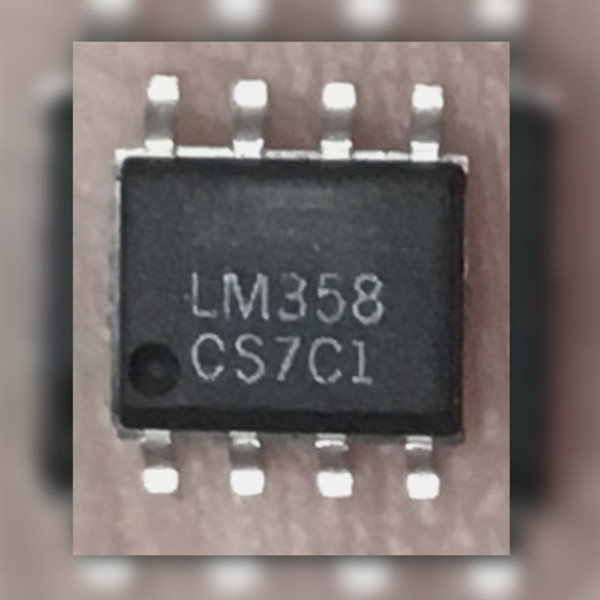
LM358 Dual General-Purpose Op Amp - Single or Split Supply SOIC-8
Condition
Unused new old stock (NOS). Clean, straight gull-wing surface-mount leads with no prior solder or socket wear. Markings legible: LM358. Sold each.
Ships same or next business day from our Idaho warehouse. Honest pricing, no nonsense.
Online since 1999. We are here for our customers, with a no-hassle satisfaction guarantee.
Product Overview
LM358 dual operational amplifier in an 8-pin SOIC surface-mount package. Integrates two independent, high-gain, internally frequency-compensated operational amplifiers designed to operate from a single power rail across a wide 3V to 32V range, or from split supplies from ±1.5V to ±16V. The common-mode input range includes the negative supply rail, enabling direct sensing near circuit ground without requiring an external negative bias supply.
Key Features
- Two independent operational amplifier channels in an 8-lead SOIC package
- Wide supply voltage range: 3V to 32V single supply, or ±1.5V to ±16V dual supply
- Input common-mode voltage range includes negative supply rail (ground)
- Low power supply current drain independent of supply voltage
- Internal frequency compensation for unity-gain stability
- Standard gull-wing surface-mount footprint for automated or hand SMD soldering
Applications
- Makers and technicians breadboarding sensor front-ends on SMD adapter boards for 5V microcontrollers
- Active filtering, audio pre-amplification, and signal conditioning in single-supply embedded systems
- Transducer amplifiers, comparator circuits, and battery-powered portable instrumentation
Frequently Asked Questions
Can this amplifier operate from a standard 5V USB or microcontroller power rail?
Yes. The amplifier operates on single supplies as low as 3V, making it directly compatible with 3.3V and 5V logic power systems without requiring negative supply rails.
How many op amps are integrated into each package?
Two independent operational amplifiers are integrated into each 8-pin package, so a four-channel circuit requires two ICs. Quantity pricing applies: the price-break table on this page shows the price per piece at every step.
The LM358 is the analog workhorse that proved single-supply op amps belong on every bench. Drop it onto your board and turn raw sensor voltages into usable signals.